
The Fight
Grappling for Justice

At first glance, it seems unlikely that Muhammad Ali and Alexei Navalny would share anything in common, and yet if we look more closely, we will see that together these two demonstrate some truths essential for our democracy and foundational for our Christian faith. Patrick+
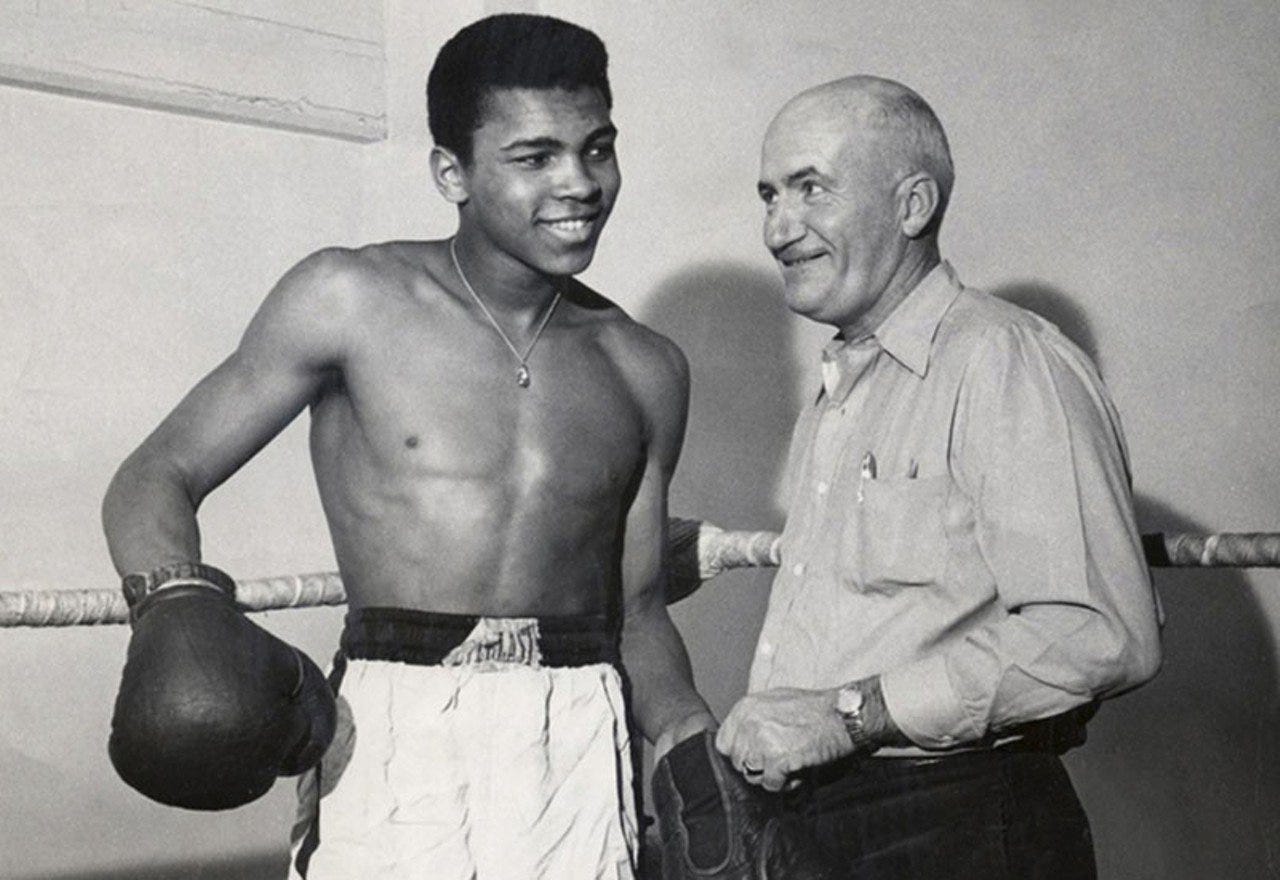
Cassius Clay, later Muhammad Ali, with his trainer Joe E. Martin in January 1960. Clay is 18-years-old, and it was his father who was the first to say, “Don’t hurt that face. He is too pretty.” Photo compliments of the Louisville Courier-Journal
The greatest by any name
The fight was over as suddenly as it began.
At mid-afternoon on Saturday, I caught the #35 at 18th Street in our little hamlet to take the crowded bus downtown. Sweltering heat enveloped the city, necessitating that the windows be opened, wreathing the passengers in diesel fumes. The Gahans still did our shopping in downtown Birmingham, even though Eastwood Mall, with its glittering interior and vast carpeted floors, had opened six years earlier. The city buses did not run regularly to the eastern suburbs, and we did not own a car.
I disembarked at 20th Street and 5th Avenue South to make my way to Loveman’s Department Store at the corner of 5thand 18th and then on to Pizitz, which was an easy three block walk north. Mother had instructed me to shop the sales for two pairs of pants and three shirts to outfit me for sixth grade. I would be scouring the bargain basement stacks in both stores looking for discontinued items and passable “irregulars”. At Loveman’s, I lingered in the housewares before making my descent to the windowless basement. Color television sets were stacked to the ceiling the entire length of the floor, all set to the same channel – ABC. Price tags of $449.99 hung on the sets, which made them as unattainable for our family as the Blue Hope diamond.
I was looking at the menagerie of electronic gadgets when Howard Cosell’s wide grin and signature toupee filled the one hundred screens, and his unmistakable clipped Brooklyn voice leapt from the one hundred speakers. The 8PM fight between Muhammad Ali and Brian London, the British Commonwealth Champion, at Earl’s Court in Kensington was being broadcast live. With the time difference between the two continents, I was in the perfect spot. The bell for the first round sounded and Ali danced around London, landing combination punches at will, while the British champion seemed glued to the mat, immovable and unable to defend against the flurry of punches. I slowly made my way through the housewares, frequently turning my head to view the bank of color screens. By the time I came to the last row of TVs, Brian London was prostrate on the mat, unmoving and unconscious.
Muhammad Ali seized my eleven-year-old imagination. No athlete combined such Herculean power with Promethean artistry. Two and a half years before, on February 25, 1964, Ali had stunned the nation and Los Vegas odds makers when he defeated the World Heavyweight Champion Sonny Liston in a seventh round TKO. Not quite a year and a half later, the World Boxing Federation ordered the two to meet again, due to the unexpected ending and result of the first fight. The contest unexpectedly had to be moved to Lewiston, Maine when a city district attorney blocked the two from fighting in the Boston Garden. No matter, Ali connected with a right fist blow and the mighty Liston was face-up on the mat in less than two minutes. Spectators had scarcely parked their cars when it was time to return home from the bout.
The bigger fight
A much greater fight was stirring for Ali, one that would not be determined in a boxing arena. Shortly after becoming the World Champion Heavyweight in February 1964, Ali publicly announced his conversion to Islam. He was initially drawn to Islam while competing in the Golden Gloves Boxing Championships in 1959. In 1961, he quietly converted. After defeating Liston, he broke the news to the world by asserting he was changing his name from Cassius Marcellus Clay, Jr. to Muhammed Ali. His fans and his family were enraged. His hometown paper, the Louisville Courier-Journal, continued to print his name as “Cassius Clay” for several years after the announcement. Boston’s refusal to welcome Ali to compete in the Boston Garden was another snub among many.
Ali despised being given a name by a slave owner – no matter how noble. He would repeatedly reiterate that he was free, and he freely adopted his new religion and freely assumed his new name, Muhammad Ali, which means, “beloved of God.”
Ali’s family was particularly proud of their handsome son, his accomplishments, and the noble sound of his name – “Cassius Marcellus Clay.” Ali, on the other hand, considered his name a link to his family’s days in slavery, and it was. The first Cassius Marcellus Clay was a Kentucky slave-owner turned abolitionist. After working with Abraham Lincoln and serving as ambassador to Russia, Mr. Clay returned home to Kentucky and freed all his slaves – granting all of them his surname as freedmen. The name carried greater esteem because they were connected to the notable U.S. Senator Henry Clay. Regardless of the lineage, Ali despised being given a name by a slave owner – no matter how noble. He would repeatedly reiterate that he was free, and he freely adopted his new religion and freely assumed his new name, Muhammad Ali, which means, “beloved of God.”[1] [2]
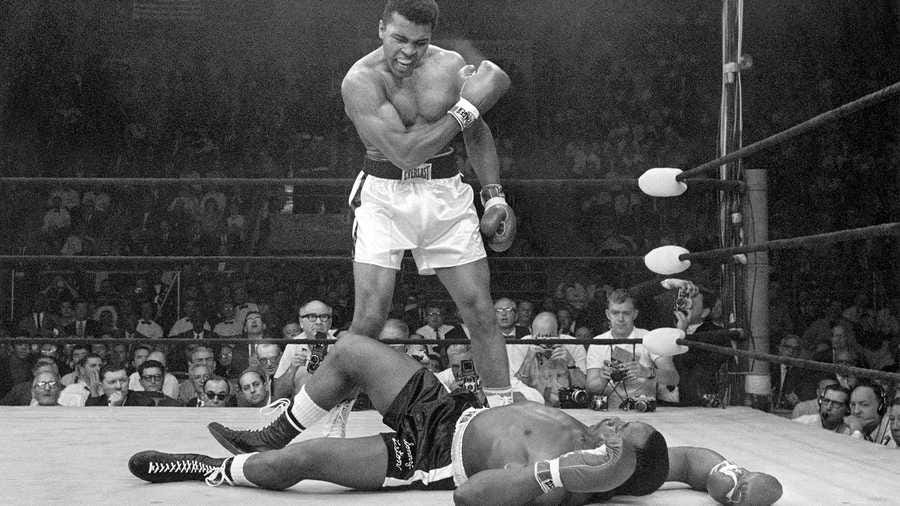
On May 25, 1965, the highly touted rematch between Muhammad Ali and Sonny Liston in Lewiston, Maine, Ali knocks Liston to the mat in less than two minutes. Photo compliments of John Rooney.
The fusillades let loose at Ali on April 28, 1967, when he refused to be inducted into the U.S. military after receiving his draft notice. Standing in front of the Houston, Texas Selective Service Board, his name was called three times for him to approach the board for his induction, but he would not take a single step forward. Earlier, he appealed to his home state authorities in Kentucky to be designated a “Conscientious Objector,” based on his devotion to Islam. The request was denied. Ali was arrested but did not serve time in prison. However, he was stripped of his title as Heavyweight Champion, his boxing license was voided, and he was not allowed to compete for the next three years, the prime years of his athleticism. Ali never retreated, taking his case all the way to the Supreme Court, where he was exonerated on June 28, 1971. During those frustrating intervening years, Ali’s influence only grew as a model for black Americans and for the anti-war effort. According to Alpha Topics, an Australian teachers’ resource, Ali’s refusal to fight in Vietnam was closely aligned to the experience of slavery in the United States:
‘I have said it once and I will say it again. The real enemy of my people is right here. I will not disgrace my religion, my people or myself by becoming a tool to enslave those who are fighting for their own justice, freedom and equality…
If I thought the war was going to bring freedom and equality to 22 million of my people, they wouldn’t have to draft me, I’d join tomorrow. But I either have to obey the laws of the land or the laws of Allah. I have nothing to lose by standing up for my beliefs. So, I’ll go to jail. We’ve been in jail for four hundred years.’[3]
Once pardoned, Ali reentered the ring and fought a total of sixty-one fights, of which he won fifty-six. He charmed and infuriated the American public with his antics and his ability to reinvent himself. Who could forget “The Fight of the Century” or the “Thrilla in Manilla” or the “Rumble in the Jungle”? Love him or hate him, every television set was tuned to his fights, regardless of the hour they were telecast. As an Army veteran reared in the deep south, I was initially among those disappointed with Ali. Now, however, I realize Ali exercised so much of what makes America the envy of the world – freedom of speech, freedom of religion, and the pursuit of justice. Looked at that way, Ali’s biggest bout was not with Sonny Liston, Joe Frazier, or George Foreman. No, his greatest fight was standing up to the status quo and insisting that America truly be “a light on a hill, the land of the free.” In this country, you can speak your mind, even if your words are not what many wish to hear, even if you speak against those in power. In this country, you can worship as a Muslim, a Jew, a Christian, a Mormon, a Scientologist, or worship nothing at all. In this country, you are promised legal representation, a trial by a jury of your peers, and the right to appeal all the way to the Supreme Court of the United States. It is not that Ali did not know the greatness of America. On the contrary, he fought to make us honor our greatness.
It is not that Ali did not know the greatness of America. On the contrary, he fought to make us honor our greatness.
Fighting an evil empire
As I write these lines in commemoration of Ali’s Worldwide Heavyweight title on this week sixty years ago and all that his notoriety led to, I cannot help but compare his victory to Alexei Navalny's death, who was in pursuit of the same freedoms Ali demanded. Navalny, who perished ten days ago on February 16, was only forty-seven years old at the time of his death, leaving a wife of twenty-four years, and two children.
Navalny’s criticism of Putin and the Russian regime intensified in 2011 when he established the Anti-Corruption Foundation and declared that the Kremlin was “full of crooks and thieves.” He repeatedly remonstrated that even though petroleum rubles were pouring into Russia, household incomes were plummeting. All the while, Putin and his fawning plutocrats were building opulent estates along the Baltic coast and elsewhere. Navalny embarrassed Putin with a video he filmed via a drone which revealed the Russian president’s lavish 160-acre Baltic palace. Built in the style of the sixteenth century Italian Renaissance, the buildings and grounds are valued at one and a half billion dollars – all garnered from slush funds Putin siphoned from Russian government accounts. To date, the video has received 130 million views.
In retaliation, Putin poisoned Navalny with the Novichok nerve agent in August 2020. Navalny was airlifted to Berlin in a desperate effort to save his life. Emerging from the hospital in September, Navalny returned to Russia only four months later in January 2021. He was immediately detained, arrested, and in February, sentenced to serve two and a half years in prison. A year later, his sentence was extended to nine years. Then, in March 2023, his sentence was extended again, this time for nineteen additional years. Navalny’s vociferous opposition to Russia’s unprovoked invasion of Ukraine further incited Putin’s fury. So, in December 2023, Navalny went missing from his prison cell for twenty days. The world would later learn that he had been clandestinely moved to an isolated prison on the Arctic Circle. His mysterious death on the 16th has provoked international protests.
Navalny, for his part, knew that his return to Russia spelled death for him. Most Westerners could not fathom why he would do so. Why did he not play it safe and protest from outside his country? At one of his early trials in 2021, Navalny explains why. In so doing, he sounds like the procession of Christian martyrs who have preceded him:
The fact is that I am a Christian, which usually rather sets me up as an example for constant ridicule in the Anti-Corruption Foundation, because mostly our people are atheists, and I was once quite a militant atheist myself. But now I am a believer, and that helps me a lot in my activities, because everything becomes much, much easier. I think about things less. There are fewer dilemmas in my life, because there is a book in which, in general, it is more or less clearly written what action to take in every situation. It’s not always easy to follow this book, of course, but I am actually trying. And so, as I said, it’s easier for me, probably, than for many others, to engage in politics.[4]
There are fewer dilemmas in my life, because there is a book in which, in general, it is more or less clearly written what action to take in every situation.
Fighting by the Book
Navalny spoke to his prosecutors about “the book.” Because of that Book, the ‘’Bible,” he has “fewer dilemmas in his life.” The path he must take was not in question. At that moment, Navalny stood as tall as Martin Luther in 1517 when he appeared before his own imperial prosecutors in the German city of Worms. Pressed to retreat from his convictions, Luther risked death by declaring: My conscience is captive to the word of God! To go against my conscience is neither right nor safe. I therefore cannot, and I will not recant. Here I stand!
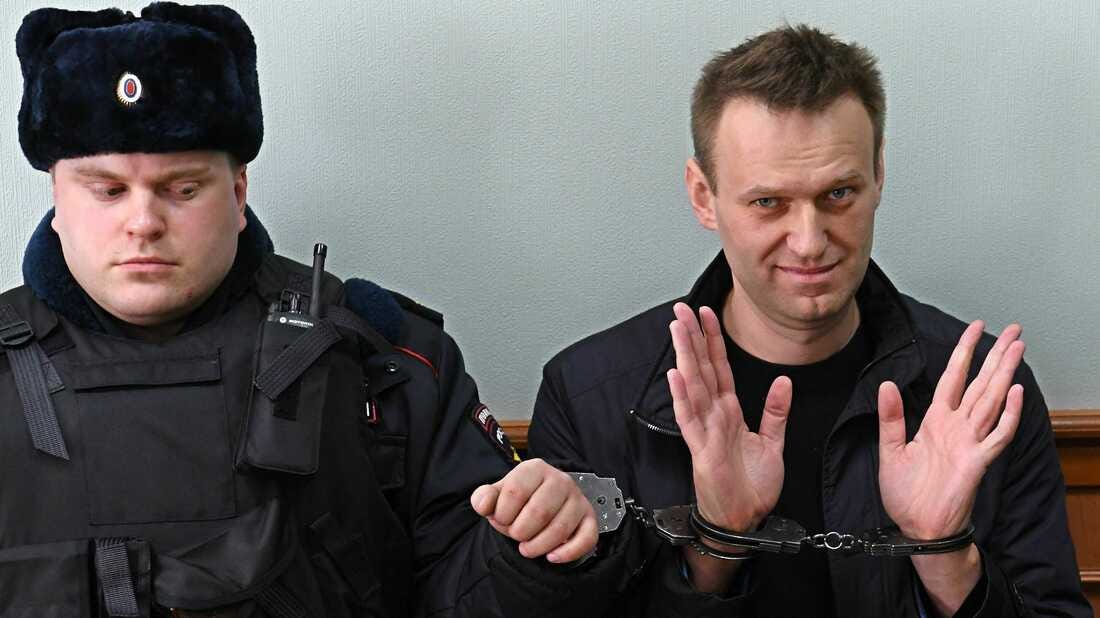
Alexei Navalny rose to fame in Russia with headline-grabbing investigations into corruption at the highest levels of President Vladimir Putin's regime. Navalny is seen here at a court hearing in Moscow in March 2017. Photo compliments of Krill Kudryavtsev, Getty Images.
The Bible is our authority
What does it mean that Luther and Navalny were captive to the word of God, that Book, the Bible? In our age, when many prominent voices in American Christianity are espousing triumphalist nationalism, materialist prosperity, and extremist fear, how could Navalny offer himself to be executed by an evil empire? First, we who “follow the book,” as Navalny told the court, recognize an authority outside of ourselves. We are not free agents. Christians have faith that the Bible is the revelation of Jesus Christ. That means the stories, poetry, songs, prophecies, and proverbs reveal the person of Christ and his will for the world as well as for each one of us. The Bible is far more than an instruction manual for believers. The Holy Spirit provides a mysterious thoroughfare so that the words will live inside of us, as the writer of Hebrews insists (Hebrews 4:12). Therefore, we do not study the Bible like we would a road atlas when trying to get from point A to point B. No, we read the Bible more like we listen to a song over and over again until we are singing it even when it is not playing on our stereo or headphones. The rhythm of the song, as much as the lyrics, take up residence in us, so that its cadence directs our march throughout our days.
We read the Bible more like we listen to a song over and over again until we are singing it even when it is not playing on our stereo or headphones. The rhythm of the song, as much as the lyrics, take up residence in us, so that its cadence directs our march throughout our days.
The Bible tells our story
Second, those of us who are captive to the Bible, begin to read in the pages that we are part of a bigger story. We follow Abraham, leaving our old life for the new. We follow Moses through the wilderness, encountering the vestiges of our old life that still cling to us. We follow David, confronting the giants who would deter us from our new life. We follow Isaiah, reclaiming the new life we slothfully cashiered through the years. Above all, we follow Christ, being buried with him through baptism into death in order that, just as Christ was raised from the dead through the glory of the Father, we too may live a new life (Romans 6:4-5). Reading the Scripture, we realize that Navalny is right: every Christian is a “dead man walking.” The Good Book assures us that we can drown out the fear of death because we have already died to our old, faux life, so that now we are part of a much bigger Story that will go on. The Putins of this world do not have the last word. The Word has the last word.
The Bible demands justice
Third, those of us drawn into the Bible cannot ignore the Lord’s revelation that He is a God of justice, and He demands that those who love Him live justly and work for justice (Micah 6:8). In Deuteronomy the last testament in the Torah, the five foundational books of Holy Scripture, Moses completes his third farewell speech to Israel and immediately breaks into song – a forty-three verse serenade, as a matter of fact! Moses opens his song warning the people not to depart from the justice reflected in the LORD and required by the LORD:
The Rock, His work is perfect,
all his ways are just.
A faithful God, without deceit,
just and upright is He;
yet his degenerate children have dealt falsely with Him. Deuteronomy 32:4-5
Before Joshua leads Israel across the Jordan and into the Promised Land, Moses tells them one last time that the LORD is a just God; therefore, this new nation He has made of them must be a land and people forged in justice – distinctly different from the nations that will surround them.
Similarly, we can look at the most lyrical words of Jesus, which are found in the Sermon on the Mount (Matthew 5:1-7:28). Emulating Moses’ ascent of Mt. Sinai to receive God’s Law for Israel (Exodus 19-24), Jesus climbs a hill in Galilee to impart the deeper meaning of the Law to the assembled people. Jesus begins his sermon poetically with nine Beatitudes, which are blessings God bestows on those demonstrating certain behaviors (Matthew 5:3-12). All nine of the Beatitudes are stark departures from the Roman imperial culture that surrounds them, a culture that prizes military and political power, lavish affluence, and exalted social standing – often at the expense of the weakest in society. In particular, the fourth blessing, ‘Blessed are those who hunger and thirst for righteousness, for they shall be filled’ (v.6), echoes Moses’ farewell song in Deuteronomy. The Greek word for “righteousness” is dikaiosuné, which means “justice as God prescribes in his unassailable righteousness.” The drumbeat of Jesus’ sermon is that God’s ways are not the ways of the world. The expeditious path taken for personal gain leads away from God’s righteousness. To be just as God is just, is “to love others as you love yourself,” which is Jesus’ commandment that he draws from the Torah (Leviticus 19:18; Matthew 22:37-39). If we take that sacrificial path today, we will likely garner the inglorious label – “Loser!”
The expeditious path taken for personal gain leads away from God’s righteousness.
Ali and Navalny both seemed to be on the losing side of history. Ali was deprived of his best years of competition. Navalny was robbed of his best years of life. Yet both believed the fight for justice – justice that would benefit other people, for the most part, was deserving of their sacrifice. The February 25 Sunday paper in my hometown printed: No athlete of any time or era occupied a larger cultural presence, consumed more attention, stirred larger controversies, and evoked more love and hate than Ali. Yet by the time of his death in 2016, he may have been the most beloved person on Earth.[5]
About Navalny, Mark Tooley, editor of the Institute of Religion and Democracy and a former CIA agent, wrote in memoriam: Of such heroes, like Navalny, Corazon Aquino, and Bonhoeffer, it can be said: ‘The world was not worthy of them’ (Hebrews 11:38). And yet God sends us such sacrificial people to do His work on earth, that humanity might glimpse justice and live more in accord with Him. May we all in response try to be worthier of the gift.[6]
[1] Hana Ali, At Home with Muhammad Ali: A Memoir of Love, Loss, and Forgiveness (New York: HarperCollins, 2019), 320.
[2] Kareem Abdul-Jabbar (trans, “noble, powerful, servant”), who also previously bore a “sporty name” – Lew Alcindor, changed his name in 1971 after his conversion to Islam. Abdul-Jabbar played 20 seasons in the NBA, after taking home three NCAA championships at UCLA.
[3] https://alphahistory.com/vietnamwar/muhammad-ali-refuses-to-fight-1967/
[4] Mark Tooley, “Navalny the Martyr”, Providence Magazine, February 20, 2024
[5] Cary Clack, “Ali shook the world 60 years ago; he had just begun,” San Antonio Express-News, February 25, 2024
[6] Tooley, Providence Magazine
I’m really sorry to hear that about Grace
Carol and I are doing well, in good health. She retired from All Saints last year but does a lot of substitute teaching, which works out well for both her and the school. I am working part time for McMackin Pharmacy, delivering prescriptions. Kim is teaching fourth grade in Lufkin and lives there. She is single. Nick and his wife, the Rev. Kellaura Johnson live in Houston. He works for Chevron and Kellaura is the Canon for Transition Ministry for the diocese. She will be helping St.Stephen's this year find a new priest. Jim Liberators has been our part time interim for almost the past two years. He comes from Pearland twice a week.