
The Cross
A Fool’s Errand


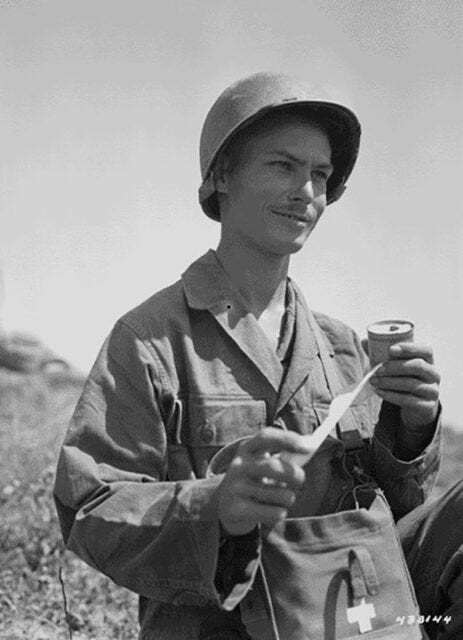
On April 1, 1942, April Fools’ of all days, Desmond Doss did the most foolish thing imaginable. He joined the U.S. Army. Already working diligently for his country’s defense at the Newport News Naval Shipyard, he could have easily secured a deferment. More notably, however, was the fact that Doss was an ardent Christian in the Seventh Day Adventist’s tradition, which meant he refused to kill another human being and would not bear arms. Three years later on May 5, 1945, his battalion was engaged in one of the bloodiest assaults of WW II, if not the entire history of warfare. His unit attempted to scale Okinawa’s Maeda Escarpment, the 400 foot sheer cliff know by the men as Hacksaw Ridge, in order to attack a heavily fortified Japanese position. Doss’s battalion was driven off the ridge by a vicious, bloody counter-assault by a teeming number of enemy troops. On that day and the terrible night that followed, the question lingered amongst the choking sulfurous smoke, the agonized cries, and the littered bodies of dead and dying GI’s. Why was Doss on Hacksaw Ridge in the first place?
The horrific night of May 5 saw every able-bodied American soldier scurry down the steep cliff on hastily constructed rope ladders – all except one soldier – PFC Desmond Doss. Unbeknownst to the others, he remained atop the ridge, skulking amongst the Japanese patrols, to rescue his wounded comrades. One by one, he harnessed their broken and bloody bodies with ropes and lowered them to the safety of the forward combat aid station. In all, Doss saved seventy-five GI’s that night; although, his fellow soldiers insisted the number was closer to one hundred. Each time Doss successfully lowered a wounded soldier to safety, he offered the same prayer, “Lord, please let me get just one more.” What would have happened to those men if PFC Doss had not remained on that gruesome ridge with them?
Six months later, on October 12, 1945, now Corporal Desmond Doss stood on the lush, manicured lawn outside the White House. On that brilliant autumn day, Doss was there to receive the nation’s highest award, the Congressional Medal of Honor. President Truman took the hand of the corporal and held it throughout the reading of the citation. Before the President loosened his grasp, he said solemnly, “You really deserve this. I consider this a greater honor than being president.” Why would the President of the United States, arguably the mightiest man on earth, make such a claim?
While Doss’s heroism makes for a sweeping cinematic story, it seems a fool’s errand to most of us. Confronted with so great a slaughter, choking smoke, tormented cries, and seething chaos, we would have fled down Hacksaw Ridge with the hundreds of other rational men. Yet one foolish man remained, and his sacrifice resulted in seventy-five men having a future as well as the countless progeny who followed them. Doss remained atop that terrible ridge for those men he saved and the procession of unnamed children who would follow. For them, he was anything but foolish.
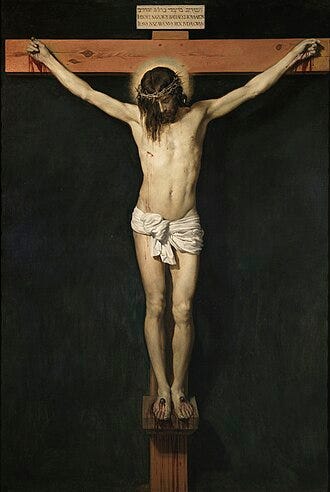
In the same way, many, if not most, believe that Christ’s tragic climb to Calvary and his ghastly crucifixion there were foolish. This consensus is hardly new. A mere thirty years after Christ was executed on the cross, Paul confronted his self-satisfied, urbane critics in Corinth with these words:
‘The message of the cross is folly to those who are perishing, but to us who are being saved it is the power of God’ (1 Corinthians 1:18).
To those who imagine they are just fine the way they are – “thank you very much” – the cross is ridiculous, macabre theater, a fool’s errand, for sure. But to those of us who know that sin threatens to destroy us, or at the very least, disfigure us into hollow, half-persons, the cross is the radiant expression of God’s glory and our only hope. The people sleeping soundly in their beds on May 5, 1945 may have wagged their heads in comfortable, distant astonishment when they fetched the morning paper from their front yards and read of Doss’s acts on Hacksaw Ridge. Those seventy-five he carried, harnessed, and lowered into the arms of the awaiting medics knew personally that Doss had saved them. A world of difference separates the two experiences.
What if Doss had not stayed atop that ridge and instead clambered down the rock face with the rest of the troops? He would have returned home to Virginia and likely been hailed as a unique hero in his hometown, a moral witness and standard. He would have had yarns to share with his children and grandchildren. No one would have thought less of him, but his story would no longer be told today because no one was saved. In the same way, many of us settle for a cross-less Jesus, one who shared insightful stories and stood as a moral vanguard against oppressive imperial power and compromised religious practice. That Jesus is admirable but cannot save, so we’re left upon the ridge with life seeping steadily out of us. That irreducible fact is what led Paul, an erudite, cosmopolitan, highly educated, citizen of his age, to confess to those same Corinthians:
‘When I came to you, brothers and sisters, I did not come to you proclaiming the testimony of God in lofty words or wisdom. For I decided to know nothing among you but Christ and him crucified’ (1 Corinthians 2:1-2).
Paul knew what every woman and man knows who has become painfully aware of our sin, our pressing need for healing, and the humbling fact that we cannot perfect ourselves. Without the cross, without Christ willingly sacrificing himself to evil men, we are lost, and our religion has little to offer us beyond catchy adages, self-improvement schemes, and an ancient, winsome role model.
This is in no way a pessimistic message. Heavens no, for once we take an honest inventory of ourselves, confess our sins to God, and ask him to put the cross between our old person and the new one we are becoming, an incredible lightness is given to us. It is as if we are standing on the White House lawn with President Truman and Corporal Doss on that bright October day. The dark storms of evil that conspired to destroy the United States and our allies were turned back by men like Doss, and the sun shone again. Likewise, the onslaught of darkness that threatened to annihilate us was defeated by the crucified Christ so that we can now walk in the light. On this accord, Christ himself predicted:
‘When I am lifted up (on the cross), I will draw all men and women to myself’ (John 12:32).
The unequaled faithfulness of God exhibited in the crucifixion of the sinless, obedient Son calls out to us like the deafening foghorn and blinding beacon of a lighthouse along the threatening rocky shore of the North Atlantic. We are the ships battered against the waves of anger, greed, lust, addiction, and un-forgiveness, when we hear his unmistakable call and are led safely back to port by his dazzling light. Christ’s voice resounds like a foghorn in the night watches, “You can be healed. You can be whole.” Paul’s contemporary, Peter, put it this way:
‘Christ himself bore our sins in his body on the cross, so that, free from sins, we might live for righteousness; by his wounds you have been healed’ (1 Peter 2:24).
The light of the crucified Christ reaches out to every man and woman. This light cannot be dulled or obscured by human ingenuity or demonic designs (John 1:5). Therefore, we should not be surprised when the light catches us while running from the truth about ourselves or knocked off our feet by self-inflicted spiritual wounds, for Jesus constantly prays, “Father, just let me get one more…just one more.”
A Prayer Offered at the Foot of the Cross
Blessed Jesus, I stand here in the shadow of your cross, where you sacrificed yourself for me. Overcome with gratitude, I confess that I have been fleeing from you and the truth about myself because I know, only too well, that I am not the person you graciously created me to be. My sin is eating away at me and because of it, I sometimes hurt those I love the most. I confess my sins to you, and I ask you to forgive me and heal me. Jesus, make me the person of your dreams. Make me more and more like you. Put your glorious cross between the old me and the new me you are fashioning through your grace. I ask this in your Name, the Name above all names, Jesus Christ. AMEN.
Next week The Letter will continue with our study of Paul’s Letter to the Galatians.
PHOTO CREDITS
Kneeling at the Foot of the Cross, photo by Amir Arefi
Corporal Desmond Doss, the only Conscientious Objector of WWII to Win the Medal of Honor, photo compliments of War History Online
Christ Crucified, by Diego Velázquez, 1632, The Prado Museum, Madrid
Thank you, Pat.
Thank you. My favorite painting too.