
Temporary
Galatians 3:15-29


Just passing through
“Clergy are temporary help.” The comment broadsided me. Serving as rector of my first church, I was young, vain, and fairly sure my name would be added to the pantheon of Episcopal all stars. By some miraculous math solely of God’s doing, the East Texas parish was growing faster than any other in the diocese, both in attendance and income, facts which served to bolster my youthful misappropriated conceit.
Regardless of my puerile hubris, the church had suddenly outgrown our facilities, such that I asked for a grant from the diocese to build a larger nursery and Sunday school rooms. The diocesan treasurer drove the ninety miles to our church to close the deal. He no sooner arrived that I began to excitedly share with him our exponential growth percentages and subsequent plans for campus expansion and innovative programming. Thinking he was impressed, I rattled on, until he interrupted me mid-sentence. “Pat, you do know that clergy are temporary help?”
I felt like I’d been slugged in the gut. Here I was regaling a top ecclesiastical official with my array of accomplishments, and all he could do was tell me I was transient help, like a seasonal farm worker. I was indignant, yet sometime later his words came true as if prophesied by Elijah. After five years, I moved on to another ministry six states away. The rector who followed me was dismissed abruptly for sexual misconduct with a staff member. In less than a year’s time, the second rector, a very pastoral, winning clergyman, suddenly left the Episcopal Church to become a Roman Catholic. The third, while he remained longer, eventually left the parish to start an alternative church in the area, thereby splintering the congregation. All the gains made during my tenure were erased like a sand castle on the beach when the tide comes in. The carefully sculpted parapets, towers, barbican, ramparts, and palisades disappear, leaving not a trace.
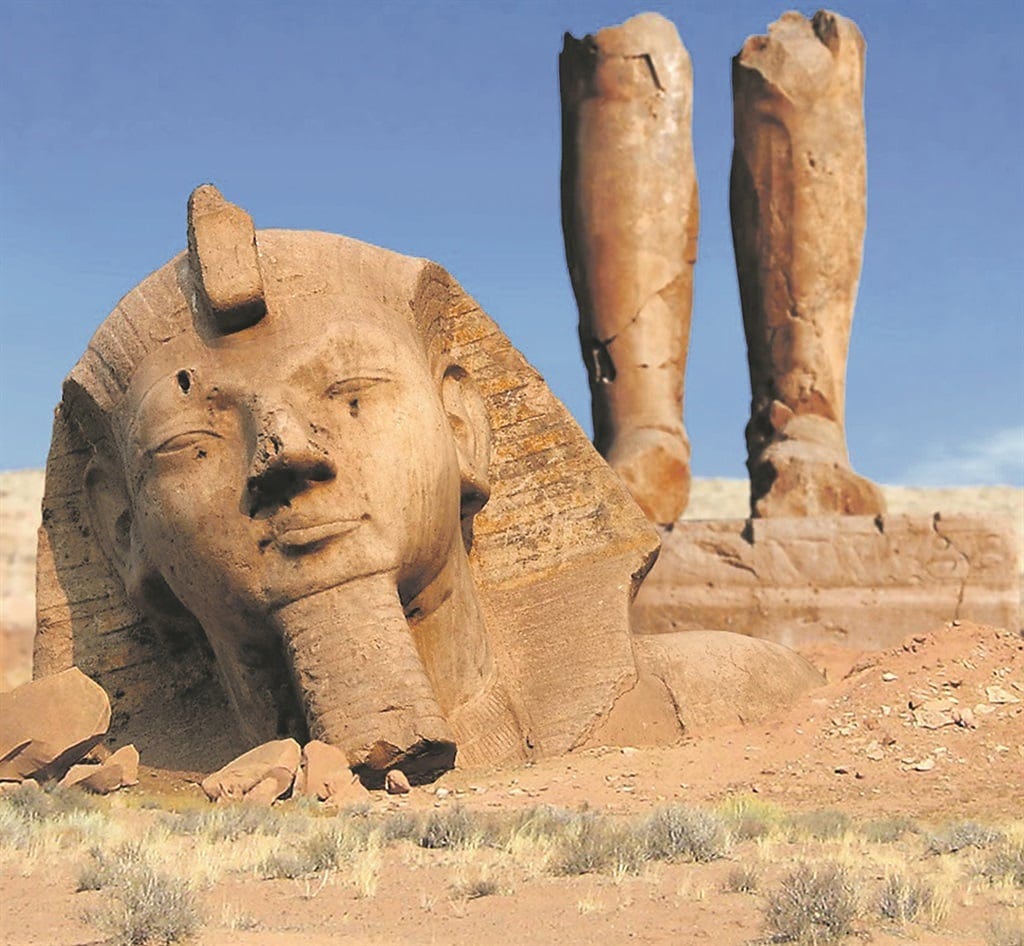
Any notion I had of some heralded legacy in that far corner of Texas was as flimsy as the cobweb precariously hanging in the far corner of my office. All at once I felt like Shelley’s Ozymandias. In Shelley’s poem, Ozymandias, the 13th Century Pharaoh Ramses, builds a colossal statue in tribute to himself. Its remains are discovered by a traveler in the Sinai desert 400 years later, who shares this observation with the poet, “Two vast and trunkless legs of stone” stand upright in the desert, but they no longer have a torso or body attached to them. Looking closely, the traveler reads the statue’s inscription on a “lifeless” block of stone:
‘My name is Ozymandias, King of Kings;
Look on my Works, ye Mighty, and despair!’
The poem then continues when the traveler adds:
“Nothing beside remains. Round the decay
Of that colossal Wreck, boundless and bare
The lone and level sands stretch far away.”
Shelley, who died at age twenty-nine, reminds readers that our dreams of immortal legacies are fruitless. No matter how many portraits or sculptures are made of our likenesses, no matter how many proclamations or pronouncements are issued to our credit, no matter how much wealth or property we hand down to our heirs…our earth’s debut is temporary. The Psalmist best captures the brevity of our lives:
God turns us back to the dust and say,
‘Go back, O child of earth’…
You sweep us away like a dream;
we fade away suddenly like the grass.
In the morning it is green and flourishes;
in the evening it is dried up and withered. Psalm 90:3, 5-6
The wise man and woman never forget their own mortality. Fantasies of imperishability do not advance but hinder our development as human beings. We really don’t have “all the time in the world,” which may propel us to make enduring deposits of love in others rather than creating lifeless tributes to ourselves.
We really don’t have “all the time in the world,” which may propel us to make enduring deposits of love in others rather than creating lifeless tributes to ourselves.
One passage after another
The brevity of our lives should come as no surprise. After all, a human lifetime is a procession of deaths. We essentially die to one chapter of our lives as we move onto the next. We look with admiration at the one who pushes through adolescence to take on adult responsibilities; whereas, we look with pity at another who is stuck in juvenility.
I have long been drawn to the Hindu understanding of our life passages. The first of the four stages is that of a student, the Brahmacharya Stage, which is a period of formal education, acquiring knowledge, and character building. The second is that of a householder, the Grihastha Stage, where after marriage the individual raises a family, pursues a career, and accrues wealth to support children and the community. Stage three is that of a retiree, or Vanaprastha, a time marked by grandchildren where the individual slows down, pushes away from business and material attachments to focus on spiritual growth. Finally, in the fourth state the individual becomes a renunciant, Sannyasa, where one renounces worldly concerns and enters more and more into contemplation and union with God.
These ancient stages were delineated in India around the 5th Century BC, about the time of the Hebrew Prophet Malachi. They are a reminder from a markedly different culture that our lives do not travel in a straight line. A spiritually healthy human being comes to the end of one stage and allows it to die in order to progress to the next. Writing this on the eve of Mother’s Day, I am reminded of my wife’s counsel to many harried young mothers in the parishes we have served. “When you are raising children you think this stage of your life will go on forever, but trust me, it passes very quickly.” In other words, savor this time when your children’s lives revolve around your own. Rather than being morbidly nostalgic about the transience of the child-rearing years, Kay often goes on to say that the empty nest stage is replete with life in a different way.
All stages of life are temporary. To cling to our children when they are adults inhibits their lives and stifles ours. To amass material possessions instead of holding them lightly and letting them go, is to retain, at most, a false hope of immortality or, at the very least, a shallow definition of ourselves. The temporality of our lives, as well as the succession of brief passages that make up our lives, are not burdens but gifts.
A community of priests
Likewise, realizing I have been “temporary help” in the churches that I have served has been a gift, too. And it has changed how I perceive congregations and transformed how I go about my work. Regarding the first, I have developed a deep humility about all parishes — large and small. In fact, I never walk into a church building that I am not overcome with a sense of the thousands, if not millions, of prayers that have been offered there before I arrived. It is a priestly role to offer prayers in the congregation. Therefore, the rector or pastor is never the sole priest leading a gathering of congregants. No, everyone in the room who has put their trust in the Lord Jesus Christ is a full-fledged priest of God.
Of all people, that all-business treasurer of the diocese led me to open the Bible to see that I was not a super priest leading a collection of underlings. Not hardly. I was just one priest amongst many. From start to finish the Scripture witnesses to this truth. At Sinai, where Israel is transformed from a rabble into Israel, God declares that they will be to Him ‘a kingdom of priests and a Holy nation’ (Exodus 19:6). In Paul’s Letter to the Romans, he states that believers in Christ offer praise and good works, such that their lives become ‘a living sacrifice’ (Romans 12:1). The Letter to the Hebrews declares believers in Christ no longer need an intermediary, for ‘they can boldly approach the throne of grace to receive forgiveness’ (Hebrews 4:15-16). In 1 Peter, believers are described as ‘living stones being built into a spiritual house and offering spiritual sacrifices acceptable to God’ (1 Peter 2:5). Peter goes on to say, those in the church have become what God envisioned at Sinai, ‘a chosen people, a royal priesthood, a holy nation, God’s special possession’ (1 Peter 2:9). Punctuating this fact, the final book of the Bible, Revelation, twice proclaims that Jesus has made his followers ‘kings and priests to God’ (Revelation 1:6 & 5:10).
Rowan Williams, the former Archbishop of Canterbury, observes that when he is sitting in a church congregation anywhere in the world and he sees the people file back to their seats from receiving Holy Communion, its as if each one has been set afire. The archbishop perceives them the way Israel saw Moses when he descended Mt. Sinai after speaking with the LORD. His face was so bright that it hurt the eyes of the beholder. Between the Bible’s testimony and the archbishop’s, I have come to view parish congregations in a whole new “light.” Those sitting in the pews, standing to sing, kneeling shoulder to shoulder at the communion rail are a radiant assembly of God’s priests, of which I am but one.
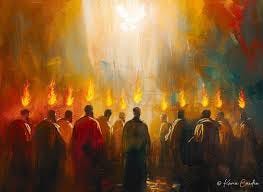
The Episcopal Church supports the view of the priesthood of all believers. For me, the most stirring moment during Holy Baptism occurs right after water is poured on the head of the individual. The presider then directs, “Let us welcome the newly baptized.” To which the congregation responds:
We receive you into the household of God. Confess the faith of Christ crucified, proclaim his resurrection, and share with us in his eternal priesthood. BCP, 308
The statement is unambiguous. The newly baptized is being welcomed into the church, “the household of God,” whose members are — everyone of them — priests.
While this Biblical view may be shared in varying degrees by the 70 million Anglicans worldwide, historically Episcopal congregations in the U.S. have had to exercise their priesthood. When Church of England parishes were being established in the American colonies beginning in 1607, the English authorities would not give them any funding, nor would they allow any bishops to oversee the congregations. Fending for themselves, they developed a democratically elected vestry system to govern and fund the infant church. The leadership for the churches did not come from the outside but emerged from within the people. Furthermore, because all clergy that served the colonies had to be trained and ordained in England, there was a chronic shortage of pastors, especially during the 17th century. The laity regularly led Morning and Evening Prayer in the churches, having to exercise their priestly roles for years at a time.
Once my understanding of the congregations I served changed, so did the understanding of my own role: I was one priest serving amongst many others. My renewed understanding was liberating. The proclamation of the Gospel, the spiritual formation of souls, the pastoral care of the hurting, the ministry to the poor, even the leading of worship — is not my work, but ours. My job as an ordained person and chosen presbyter is to remind the people in the pews that they are the priests of God and to inspire and train them to undertake their role. In most congregations this takes a lot of getting used to, for most Christians today perceive their part in the church as a passive one, certainly not that of a priest. That view is also convenient because it foists all the spiritual and pastoral responsibility on the professional clergy. This is a deadly recipe, leaving congregations to repeatedly await the arrival of their next Moses and then watch their vitality and numbers decline when a beloved pastor leaves or retires.
My fellow clergy, even some of my closest friends, almost groan anytime I utter the phrase ‘priesthood of all believers.’ A few even seem to have their eyes roll back in their heads. I continue to beat this drum because I do not know how the church will ever get healthy until we realize we are priests and undertake the attendant role and responsibilities. Some clergy, I imagine, worry that if the people in the pews come to know they are priests then the clergy’s special role will be diminished. Not at all. The priestly people making up a congregation need a lifetime of training and forming. Every parish becomes its own seminary. The role of the pastor is not lessened but magnified…but with just one important caveat, the clergy work amongst equals — not subordinates.
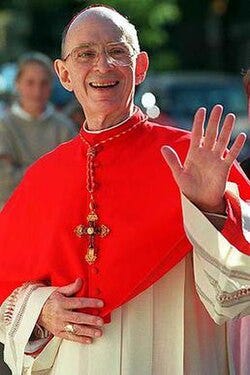
Accordingly, I shed my titles, i.e. “Father,” “Doctor,” “Reverend,” and so on, some fifteen years ago. I am not ashamed of the titles. I earned them and clung to them for a long time. Perhaps I needed the titles during that earlier passage of my life. A sudden awareness took hold of me. If all believers in Christ are made “priests” at our baptism, then shouldn’t I, too, go by my baptismal name, “Patrick?” I suppose I was influenced by the late Joseph Bernadin, who upon being named the Roman Catholic Archbishop of Chicago in 1982 and Cardinal in 1983, routinely introduced himself to congregations by invoking a line from Genesis, “I am Joseph, your brother.” On public busses and trains in Chicago, which he continued to use, he would tell other riders, “Just call me Joe.”
Bernadin seemed to have a premonition about the temporary nature of his life. At age 68, only thirteen years after his elevation to cardinal, he was diagnosed with pancreatic cancer. When the cancer metastasized to his liver, he turned over the leadership of the archdiocese to an auxiliary bishop and wholly devoted himself to ministering to other cancer patients at Loyola Hospital in Chicago. He died as he lived, holding lightly the vaunted titles bestowed on him, while holding closely those entrusted to his care, knowing full well that love alone endures.
Temporary measures
Pointing out the difference between what endures as opposed to what is temporary is an overriding concern of Paul’s. In Galatians, as well as in his later Letter to the Romans, the apostle points out how the Mosaic Law’s role as a temporary measure meant to lead to the life of faith. Never was it conceived by God to be an end in itself, but rather the Law was to introduce the more expansive life of faith as witnessed in the life of Abraham. Paul, in fact, cites that the Law was given at Sinai 430 years after God had already made His covenant with Abraham based on the patriarch’s faith (Galatians 3:17). The Law, therefore, was not given by God to surpass his promises first made to Abraham but to support them.
Here it is important that we step back and consider why the covenant made with Abraham is so enduring and liberating. First, we should recognize the context of Abraham’s call from God. The call follows two dark stories in Genesis: the Great Flood (Genesis 6-9) and the Tower of Babel (Genesis 11). In the first, God destroys the earth over his disgust with humanity, and in the second, God separates and disperses humanity across the globe because of their arrogance and idolatry. The downward spiral from Eden and Cain had never been arrested. Unexpectedly in Genesis 12, just after God has dispersed human beings into the far corners of earth, He calls Abraham to leave his ancestral homeland at the confluence of the Tigris and Euphrates Rivers in present day Iraq and ‘travel to a land that I will show you…and I will make of you a great nation’ (Genesis 12:1).
Although he is seventy-five years old, Abraham does as God commanded him and leads his family on the 1,200 mile journey. Arriving in Canaan, their destination, it is not long before Abraham bewails to God that he cannot ‘become a great nation’ when he and his wife Sarah have no child and are well beyond childbearing years. It is the dead of night when Abraham makes his lament, and God, in turn, invites Abraham to step outside his tent and count the stars in the sky if he can. God then says, “So shall your descendants be” (Genesis 15:5). The Scripture then records Abraham’s concise response, ‘Abraham believed the LORD and the LORD credited it to him as righteous’ (Genesis 15:6).
In other words, Abraham was in a relationship with God because he trusted Him. This, after all, is what God had desired from the beginning of His creation — a trusting relationship with humanity. Looked at against the backdrop of the Flood, the Tower of Babel, Cain’s murder of his brother Abel, and Adam’s and Eve’s duplicity in the garden, Abraham is God’s restart of humanity. While not perfect, Abraham is the new man who demonstrates the faith God relishes in us. That is why Genesis 15:6 — ‘the righteous shall live by faith’ — is echoed throughout the Bible — Habakkuk 2:4; Galatians 3:11; Romans 1:17, and Hebrews 10:38.
So, Abraham’s demonstrated faith in God’s promises is the gold standard of the Bible — and, indeed, of Israel. The Law given at Sinai is subordinate to the life of faith. In fact, the Law’s purpose is to reveal how poorly we often are at living in fidelity and trust with the LORD. To this, Paul throws out a rhetorical question and its answer: ‘Is the Law then opposed to the promises of God? Certainly not!’ (Galatians 3:21a). Yet then just as quickly Paul makes it clear that the Law cannot, in any way, confer life with God the way that faith can (Galatians 3:21b).
If that’s the case, why did God roll out the Law in the first place? Paul tells us that ‘the Law was our disciplinarian until Christ came, so that we might be justified by faith’ (Galatians 3:24). The apostle’s imagery is particularly effective. The ‘disciplinarian’ Paul has in mind was known in the 1st century Roman world as a paidagōgos, a senior household slave who watched over the young son of a prosperous household to keep him out of trouble. The oversight of the paidagōgos would continue until the son entered adulthood and came into his promised inheritance.
Paul compares the Law to a paidagōgos. It temporarily served as humanity’s guide until the appearance of Jesus Christ. To that point, Jesus declares, ‘Something greater than the temple is here’ (Matthew 12:6). He is saying that he embodies the immense grace and love of God that goes far beyond the dictates of the Law and the cycle of temple sacrifices.
In all fairness, the ancient Hebrew prophets and poets perceived the Law, not as a list of 613 demands, but as the will of God to be taken to heart. Psalm 1 declares for instance: ‘He who delights in the Law shall become like a tree planted by springs of water bearing fruit in due season’ (Psalm 1:3). No doubt Jesus had this psalm in mind when he spoke to the Samaritan woman at the well: ‘I will cause a spring welling up into eternal life to rise up within you’ (John 4:14).
I would hasten to add that most of us need the Law until our spiritual outlook matures to see the expansiveness of our life in Christ. Paul lyrically describes this necessary spiritual transition in his most quoted piece of writing; ‘When I was a child, I talked like a child, I thought like a child, I reasoned like a child. When I became a man, I put away childish ways’ (1 Corinthians 13:11). When we are young or perhaps new in our Christian faith, we need the basics in black and white. But our life in Christ is so much richer than a series of do’s and don’ts. When Christ calls us, we are like Abraham with a new world and new life unexpectedly opening up before us. We are suddenly called out on a lifelong journey where we are shaped by the increasing knowledge of God as revealed in Jesus Christ. Like Abraham we have the faith that there is always more to come. That is a far cry from merely trying to live between the lines or checking the right boxes for a ticket to heaven after death.
No indeed, Paul wants us to know that a largess of life, such that we never imagined, is available to those who grow beyond the temporality of the Law to undertake the eternal faith of Abraham. In his Letter to the Ephesians, Paul speaks of ‘becoming mature and attaining to the whole measure of the fullness of Christ’ (Ephesians 4:13). When that happens, our vision expands with our spirit. No longer do we see lines separating people of faith, regardless of their origin, flavor of worship, race, nationality, or family composition:
‘For now that faith has come, we are no longer subject to the black and white world dictated by a disciplinarian, a paidagōgos, for in Christ we are all children of God through faith. As many of us who have ben baptized into Christ have now been clothed with Christ. So, there is no longer Jew or Greek, there is no longer slave or free, there is no longer male or female; for all of us are one in Christ Jesus. And if you belong to Christ, then you are Abraham’s offspring, heirs to the promise he long ago received.’ Galatians 3:25-29
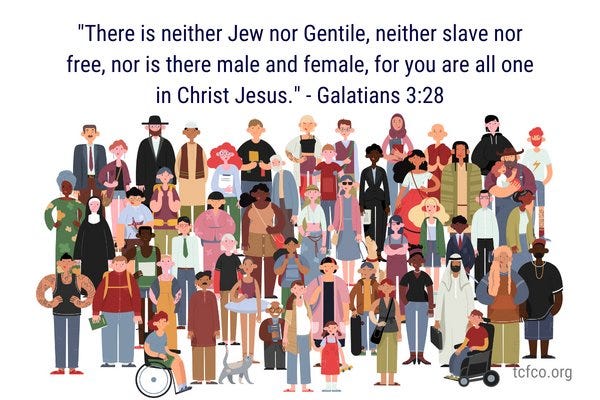
PHOTO CREDITS
Temp Wanted Sign, compliments of Linkedin
Ozymandias, compliments of Susan English
Tongues of Fire, compliments of Kevin Cardenart
Joseph Bernadin, compliments of Wikipedia
No longer divided, compliments of Teluga Christian Fellowship of Colorado
I remember that time well. When people asked me what I would do when people were leaving the church and some following the priest who left, my reply was this is my church and the priest is only temporary. Thank you for the post.
Pat, thanks so much for this thought-provoking and encouraging offering. You make a compelling case, and this Vanaprastha stage retiree is humbled to be considered part of a community of priests.