
Table Manners
Galatians 2:1-21 - Turning the Tables

Dear Friends of the Pilgrim Letter,
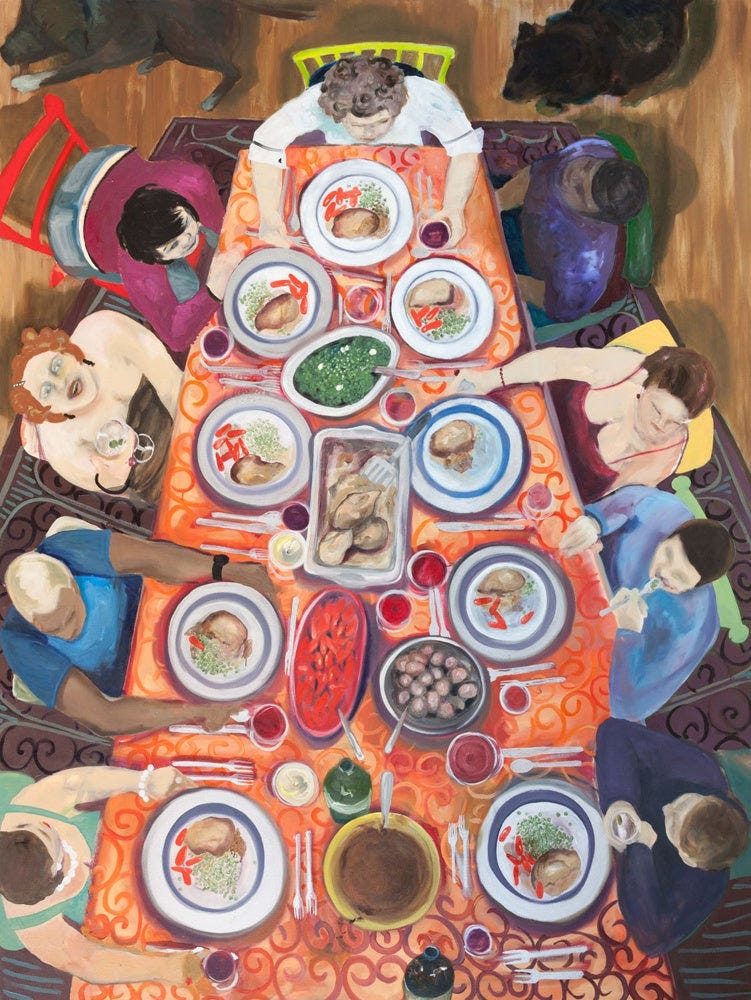
Most of us give little thought to what we eat, much less with whom we eat. We choke down a granola bar with our coffee, pick up a burger in the drive-thru for lunch, and sit at a TV tray for supper not realizing that we are ignoring the most routine sacred act. To share a simple meal with another Christian may be our most consequential we do.
Paul centers his Letter to the Galatians, not on abstruse theological propositions, but on table manners — who we invite to eat with us. This should not surprise us. Most of our churches are centered around tables, concrete symbols of our life in Christ, a life that is meant to be graciously shared with others.
These days, however, many American Christians live a hyper-privatized version of our faith. The good news is that we can change that, transforming most any meal into holy communion.
Thank you for joining me on the Greatest Adventure, Patrick
A PLACE AT THE TABLE
In 1969 I entered a strange new world. I was fourteen when I enrolled in a monastic boarding school that seemed more connected to a mysterious medieval past than to the rollicking, rebellious 1960s. Habited monks moved furtively across the campus, incense clouds billowed through the chapel doors, and on many mornings a shroud of fog sat upon the quad, accentuating the school’s otherworldly aura. During my early days there, I thought I had awakened on the set of a Bela Lugosi horror film.
A reclusive nun taught ancient history, Latin, and Greek, with the conviction that all beneficial wisdom ended with Zeno, Plato, Seneca, and Cicero. Further perplexing me was the fact that I was no longer a ninth grader but a “third former,” and I was not in my fall semester but attending “Michaelmas term.“ Our English teacher, Mr. Jones, assigned us to read The Outsiders, by T. E. Hinton, which was the only indication we were inhabiting the 20th century.
The school’s most consistent vestige of a bygone era was formal meals. Both at lunch and dinner we sat at assigned tables, and at the evening meal, regardless of temperature, students were required to wear a coat and tie. A “master,” a teacher or priest, presided at the head of the table with the rest of us seated in descending form order in a counter-clockwise arrangement. Sixth and fifth formers sat at 11, 10, and 9 o’clock, and so on, leaving us lowly third formers situated at 1, 2, and 3 o’clock. The seating was hardly arbitrary, because all food bowls and platters were passed in a counter-clockwise direction. Many nights I settled for lima beans and cornbread. In a school where the sixth formers were charged by the headmaster to “uphold the traditions of the school,” no one dared to cry foul or request, “More, please.”
Forgive my invocation from David Copperfield. Truthfully, I loved my strange, anachronistic boarding school from the first day I arrived. I loved the arcane, masculine, deeply religious atmosphere of the place and the melange of boys — most of us were boys in those early days — who matriculated there. We hailed from most every state, with all manner of temperaments, from all social and economic orders, and from all races. Ours was the first private school in the South to integrate. To that end, a tobacco heiress devoted the corpus of her considerable income to seek the highest academically performing black students throughout the South and offer them full scholarships to boarding schools like ours. Imagine my culture shock to discover that the smartest kids in class were black.
I, too, received a full scholarship, not because of my stellar scholarship, but because of my family’s extreme poverty. The monks had mercy on a number of us poorer kids. At the same time, the school drew many boys from wealthy families.
The multifarious make up of our student body hearkens me back to our formal, sit down meals. Granted the fare was simple, and at times when the school’s funds were low, the food was downright spartan. Nevertheless, we all ate together, rotating table assignments, both for lunch and dinner, every six weeks. This meant that no one could be avoided. No one could be ignored or anathematized. Twice a day we had to sit at the table with one another. Until that time, I had never shared a meal with a black person — very few from 1960s Birmingham had done so. But at the same time, I had never sat at a table with wealthy kids either. My life was conformed to my race, economic strata, and the fact I was being raised by a single mother — which deemed me a pariah in polite southern circles.
White trash
In fact, not long before I went away to boarding school, I helped our next door neighbors put a new asphalt shingle roof on their home. By that time, we had lived next to our neighbors, a blue-collar working class family, for several years. Their son was my age and my constant companion. On the day of the big roofing project, I eagerly joined my friend, his dad, and our neighbors’ cousins in hauling the roofing tiles up the ladder and then setting, tarring, and nailing the tiles in place. It was hot, dirty, and thoroughly exhausting work. However, a savory award awaited us, its aroma wafting from the kitchen, over the eaves, and onto the roof where we toiled. When our work was complete, all the workers were invited to share a fried chicken dinner, the piece de resistance of southern cuisine. Climbing down the ladder to join the rest of the crew, I heard my friend’s mother say, “Just hand Pat a glass of iced tea. I don’t want that white trash sitting at my table.” I was humiliated and devastated that longtime neighbors held that opinion of me.
That’s why the family-style meals at my boarding school meant so much to me. I could suffer through a supper of lima beans and cornbread. Belonging meant far more to me than calories, and that’s saying a “mouthful” since all teenage boys are voraciously hungry all the time. The monks were wise to demand we share meals in this way. Our schoolmates could not remain strangers, no matter how different we were from one another. The monks were also Biblically astute. Jesus forges his revolutionary community — not with memorable platitudes and lists of core values — but by having those disparate people drawn to him sit at tables and eat together. Still today, of all the things Christians do together, the most intimate and transformative is to share a table.
Sharing a table during Lent and Ramadan
Of all places, I was reminded of the importance of eating together, not by Christians, but by Muslims. A friend sent me a Wall Street Journal article comparing out Christian Lenten practices with those of Muslims during Ramadan. For the first time in thirty-three years, Lent and Ramadan take place at the same time. In fact, this year Ramadan began the evening before Ash Wednesday.
The author of the article, Stephen Adubato, is a devout Christian and a professor of philosophy and theology at Seton Hall. Recently, Adubato was telling a Muslim friend about Christian practices at Lent, such as abstaining from meat on Fridays and eating only one full meal on Ash Wednesday and Good Friday. His friend responded, “kinda sounds like diet Ramadan.” During the thirty days of Ramadan, Muslims go without food or drink from sunup to sundown.
Comparing the athletic religious disciplines of Christians versus Muslims is not the core of Adubato’s message. His main interest is not the rigor of our respective fasts, but rather what we do to mark the conclusion of our fasts. Christians, for the most part, conduct their Lenten fasts as a matter of personal piety. Perhaps taking Jesus’s admonition about fasting to a stoic level, ‘When you fast, do not look dismal as the hypocrites do…’(Matthew 6:16), we do not share the experience with other Christians. Muslims, on the other hand, always come together at sundown to break the fast. Encountering this fact in his own multiethnic neighborhood, Adubato laments:
There’s something compelling about Muslims’ making harder sacrifices in the midst of our instinct-driven, self-indulgent culture. I wish the Christian observance of Lent had the communal dimension Ramadan has, with the breaking of the Muslim fast almost always done together at the mosque, at home or in restaurants. (Adubato, WSJ)
Reading the article, I am reminded that Westerners’ extreme individualism degrades our Christian life into a lifeless “me and Jesus” arrangement, where we personally contract with our Savior to deliver us from planet earth when the time comes. Nothing in the New Testament could lead us to such an empty conception of our religion. We are saved by Christ and fashioned by the Holy Spirit to experience life together, regardless of our differences. The table at my boarding school provides a ‘colorful” example. It is doubtful that the eight of us — black, white, rich poor, urban, rural — sitting across from one another in the dining hall would have ever elected to share a meal together except that the school chose each one of us to attend school there. In somewhat the same way, Christ chooses each one of us to follow him — ‘you did not choose me, but I chose you…’ (John 15:16) — to live a very different kind of life, not in solitary but with the community where he places us. We belong at the table with each other, for it is in the company of other believers that we are reminded of who we are because of Whom we worship.

TABLE FELLOWSHIP or WHAT’S GOT PAUL SO HOT UNDER THE TOGA?
But when Peter came to Antioch, I opposed him to his face, because he stood self-condemned; for until certain people came from James, he used to eat with the Gentiles. But after they came, he drew back and kept himself separate for fear of the circumcision faction. Galatians 2:11-12
“You are what you eat,” is a familiar adage. Yet it may be far more accurate to say, “You are where you eat.” Paul’s entire Letter to the Galatians is encapsulated in his confrontation with Peter over where he eats his dinner. At Antioch, when Jewish-Christian emissaries from Jerusalem show up, Peter will no longer dine at the same table with Gentile-Christians, for he does not want to be observed breaking the Jewish food and social purity codes. Paul, never a shrinking violet, gets right in Peter’s face and tells him that ‘he stood self-condemned’ (2:11). For Paul, if the gospel creates one new humanity in Christ, segregated tables, dividing Jewish-Christians from Gentile-Christians are a brazen contradiction of that promise
Paul would wince at my terms Jewish-Christian and Gentile-Christian. He contends that in Christ we are forged into a single body. Therefore, table fellowship is not some arbitrary nicety; it is a living example of who we have become in Christ. Gentile believers are not second-class, b-team members of the church. Heavens no, we have been made one family in Christ. Secondly, the reason Peter stands condemned in this matter is his public refutation of justification, the power of God’s grace that makes believers one body. Paul uses this term in its noun, verb, and adjective forms over 100 times in his various letters. Justified is translated from the Greek verb, dikaioutai, which is a forensic term taken from courts of law meaning to “acquit” the accused. But there is more. The person who is justified is made righteous through God’s power of grace, a power completely beyond the believer’s control. In other words, each one of us stands before God guilty as charged. However, Jesus Christ faithfully goes to the cross and undergoes the punishment we deserve. We put our faith in his faithful sacrifice, and he acquits us of our sins. Some six years later, in his Letter to the Romans, Paul will explain Christ’s gift in this way, which is the centerpiece of the good news:
Very rarely will anyone die for a righteous person, though for a good person someone might possibly dare to die. But God demonstrates his own love for us in this: While we were still sinners, Christ died for us. Romans 5:7-8
His faithfulness clears us unrighteous sinners completely and refashions us into righteous persons. Now that all believers — of every color, ethnicity, and social class — are saved by Christ’s grace-full act, how can we possibly maintain divisions between us?
This confrontation between Paul and Peter has immense historical overtones. The Letter to the Galatians was foundational to the Reformation. Martin Luther curiously called the Letter “my Katy von Bora,” which was his wife’s name. Luther relied on the letter so much that he considered it his wife, his sacred partner, because it provided the essential Biblical argument for a faith-based understanding of salvation over and against a works-based salvation. The Reformation made much more room at the table!
Now, lets take a detailed look at the entire chapter.
Jerusalem Visit & Apostolic Recognition OR ‘Don’t give an inch to these bums!’ Galatians 2:1-10
‘Then after fourteen years I went up again to Jerusalem with Barnabas, taking Titus along with me. I went up because of a revelation and set before them... the gospel that I proclaim among the Gentiles…’ Galatians 2:1-2
After Paul returns from his 1st missionary journey that takes him to Galatia, yet before his 2nd missionary journey that will take him back to Galatia and then on to Greece, he finds it necessary to return to Jerusalem. The influence of the false teachers is growing, and Paul asks that the Christian leaders in the Holy City, notably James and Peter, put an end to these interlopers’ devious meddling. Paul purposely takes Titus with him, an uncircumcised Greek convert, to more personally push the question. The meeting is set to be private — not some spectacle. Furthermore, Paul insists that he was not summoned by the hierarchy but was lead to them through a personal revelation from God (2:1-2).
The private tête-à-tête goes well at first. The gospel message he was sharing amongst the Gentiles met with the others’ approval, and Titus was not compelled to be circumcised (2:2-3). All is going swimmingly until a bunch of the false teachers, or as Paul terms them, false believers crash the private party, but they cannot sway Paul or the Jerusalem leaders. Paul’s determination to make no deals with the false teachers is illustrated in the Greek phrase he uses — oude pros hōran, which means “not even for a single hour” or “not for a moment” did they consider a compromise with these meddlers. Why not just to keep the peace? Because the gospel message cannot be compromised (2:5 & Acts 15:1-11).
Of course, Paul could be cavalier, if not down right abrasive. He writes that the three main leaders of the Jerusalem church, James, Peter, and John, ‘contributed nothing to him’ and conceded the ministry to the Gentiles to Paul’s people and they would continue to minister amongst the Jews. The trio did make one appeal to Paul and his cohorts — to ‘remember the poor’ (in Jerusalem), which Paul aggressively undertakes (2:6-10). Note: Only in the Acts 15 record of this meeting, Paul’s group is asked to ‘abstain from food sacrificed to idols and to refrain from unchastity’ (Acts 15:29).
The Antioch Confrontation OR Some things are easier said than done — Galatians 2:11-14
Other Jews joined Peter in his hypocrisy, so that even Barnabas was led astray by their hypocrisy. But when I saw that they were not acting consistently with the truth of the gospel, I said to Peter before them all, “If you, though a Jew, live like a Gentile and not like a Jew, how can you compel the Gentiles to live like Jews?”’ Galatians 2:13-14
The key word in this passage is “hypocrisy” (2:13). The Greek word that Paul uses is not the familiar hypokrites but sunupokrinomai, which is collective and means “to join others in an act of hypocrisy,” “to play a part in an act of deception.” Demonstrably, the fallout of Peter’s hypocrisy is that other Jewish Christians and even Barnabas, who has accompanied Paul both to Galatia and to Jerusalem, turn their backs on the Gentile believers and refuse to sit with them at meals. The word elucidates how destructive it can be to “follow the crowd.”
Paul calls down Peter with a rather cryptic censure ‘If you, though a Jew, live like a Gentile and not like a Jew, how can you compel the Gentiles to live like Jews?’ (2:14) Grant Richison, a professional Ice Hockey player turned pastor, carefully clarifies this somewhat circular passage:
Paul says that Peter, as a converted Jew, accepted Gentiles as a principle of grace into the body of Christ. He lived as a legalistic Jew before his conversion, but after becoming a Christian and especially after his revelation that Gentiles were accepted into the body of Christ (Acts 10), he believed in and practiced the grace principle. If Peter accepted grace, how can he go back to legalism? It is impossible to have both. If he was right under grace, he is wrong to return to the law. He cannot simultaneously live under both law and grace; the two beliefs are mutually exclusive. (Richison, Verse by Verse)
A practical truth is rendered in the confrontation between Peter and Paul. The Jerusalem agreement that there is no distinction between Jewish and Gentile believers, is far easier to reach in a private meeting than in the public arena (Acts 15:6-11 & Galatians 2:1-10). Maintaining this egalitarian path under community pressure to do otherwise can be tough sledding.
The Big Question OR ‘Did Jesus die for nothing?” - Galatians 2:15-21
‘We know that a person is not justified by works of the law but through faith in Jesus Christ, so we also have believed in Christ Jesus, in order to be justified by faith in Christ and not by works of the law, because by works of the law no one will be justified.’
Galatians 2:16
Paul begins this theological section of Chapter 2 with a personal concession. He admits that even those who are Jewish by birth know they cannot be set right with God by keeping the law but only through faith in Jesus Christ (2:16). The essential meaning of the phrase, faith in Jesus Christ, has long been debated. In Greek, pistis Christou, can be interpreted two ways: The first, faith in Jesus Christ, means the believer puts his trust in the person of Jesus Christ. This has been the dominant interpretation. However, the second, faith of Jesus Christ, which also grammatically correct in the Greek, is equally compelling. The believer in this case, puts his faith in Christ’s faithfulness to God. In this latter understanding, the believer realizes he is not made right with God through his act of believing but through trusting in Christ’s fidelity to God. Specifically, Christ obediently sacrifices himself on the cross (see Philippians 2:5-11). We’ll see that Paul expresses this second interpretation at bit later in the chapter (2:20).
Next Paul tackles another sticky question that must have been hurled at him by one of the interlopers. Essentially, the query is ‘If believers put their trust in Christ, which moves them away from trusting the law, does that make Christ an accessory to sin for drawing people away from the law?’ Paul’s answer is explosive — mē genoito, meaning “Absolutely not!” or perhaps better said “God forbid!” (2:17) What Paul says next is both surprising and ingenious: ‘If I build up those things which I tore down, then I prove myself a transgressor’ (2:18). He creates an image of demolition and reconstruction. Paul admits that he has “torn down” something — the wall of Torah observance as the marker separating Jew from Gentile within the believing community. God, through Christ, has ended the hurtful nonsense that Peter and Barnabas fell prey to earlier when ostracizing Gentile believers. The gospel is not made up of abstract reasoning but of concrete, flesh and blood relationships with God and with one another.
The power of this relational faith through Christ is magnified in Paul’s startling personal statement that follows: ‘I have been crucified with Christ; it is no longer I who live, but Christ who lives in me; and the life I now live in the flesh I live by faith in the Son of God, who loved me and gave himself for me’ (2:20). The apostle is saying that he has undergone a death to his old life trying to fulfill the law, which was an impossible task. In fact, the law actually led to Jesus’ death; therefore, Paul participates in Christ’s death. His faith now is in the faithfulness of Christ — not in his own fallible abilities. Also note that Paul’s relationship with Christ is not merely transactional, but he now experiences a mystical union with him — ‘it is no longer I who live, but Christ lives in me.’
Paul ends his theological argument with a bang of the gavel: ‘I do not nullify the grace of God; for if justification came through the law, then Christ died for nothing’ (2:21). The cross either means everything or it is meaningless. There is no middle position. To add legal observance to faith as a co-ground of justification is not to supplement the gospel but to nullify it — to declare that the death of Christ was unnecessary.
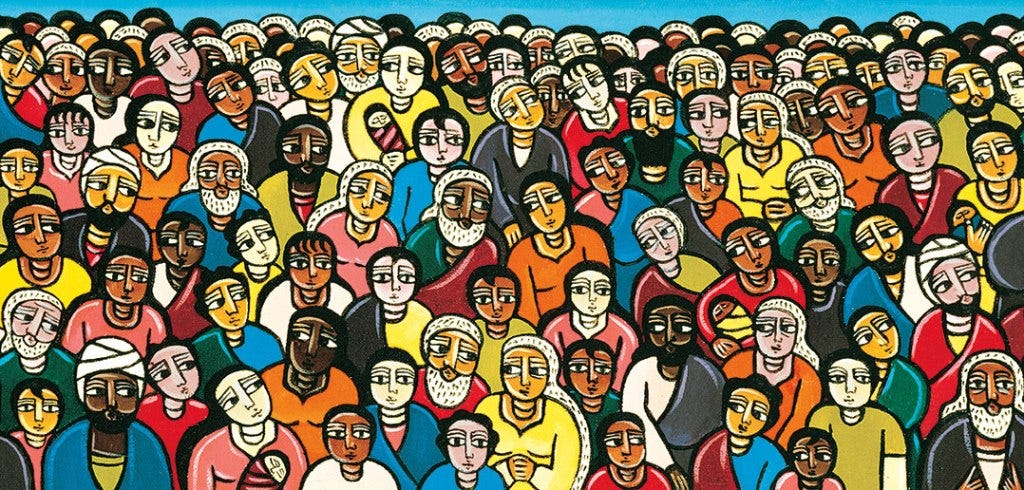
Furthermore, when Christians separate themselves from other Christians because of differences in race, cultural understanding, economic or social standing, political leanings, or points of view, we are graphically denying the grace of God as demonstrated in Christ’s faithfulness. Our salvation is solely a gift. Therefore, our tables should be considered an extension of that gift completely open to the colorful array of those drawn to our Savior.
SOURCES
Adubato, Stephen, “What I Learned about Islam during Lent,” Wall Street Journal, March 19, 2026. https://www.wsj.com/opinion/what-i-learned-about-islam-during-lent-82992063?st=ZQ3ZpK&reflink=article
Richison, Grant C., Verse by Verse, Bellingham, WA: Logos Bible Software, 2006.
PHOTO CREDITS
The Dinner Party, by Tracy Ostmann-Haschke, Chicago, IL
Muslims Breaking the Fast During Ramadan, by SBS News Australia
The Beautiful Diversity of Christians, by Peter Graystone, Emmanuel Church, Croydon, U.K.
Thanks, Pat. I had never considered the “mystical union” you describe here, that it’s the Faith OF Jesus more than our faith in Jesus Christ that’s at work, and how reassuring that is when I consider how fickle my own faith can be. As you remind us, “the cross . . . means everything.” What a timely Lenten reminder! In this vein, Susan and I have been re-watching an episode or two of THE CHOSEN most evenings throughout Lent. At the end of Season Four, there’s a re-imagined depiction of Lazarus’s sister Mary pouring the expensive perfume on Jesus feet and wiping his feet with her hair. A Pharisee who has been stirred by Jesus’s words and miracles is in attendance, and an amazing debate breaks out between this Pharisee, who wants to believe Jesus is the promised Messiah, and Jesus, who is trying to convince him that He is not drawing people away from the Law. Your words here resonated with me while I was watching that confrontation.
Thank you for your transparent honesty and sharing the pain of your young heart. How can people be so cruel? And yet it continues. I am thankful for your words and guidance.