
Reunion
Luke 24:1-35 Reunited with Jesus


Dear Friends of the Pilgrim Letter,
When we buried our daughter in Birmingham the week after Christmas, we were surrounded by a legion of family members, many we had not seen in decades. Huddled around that small gravesite on the south side of our home church, Kay and I were lifted up by their presence. In the most glorious sense, this was truly a family reunion.
In much the same way, at the end of Luke’s Gospel, a despairing husband and wife are joined by Jesus on their walk home to Emmaus. Their reunion with their Savior and Messiah lifts them out of the quagmire of their despondency. Luke alone tells this story to show believers of every age how they must come to see Jesus in other Christians and come to deeply believe in his will for our lives through the Scriptures. Both are essential in our reunion with God.
Reunion is necessary in our national life, as well. We must stay yoked to our founding principles articulated in the Constitution, the Declaration of Independence, and in the lives of faithful citizens who have gone before us. The failure to keep a foot set solidly in our past can make us susceptible to the degradations of fascism.
Finally, as this is the last of our lessons in Luke, I must report the death of the scholar who led me on this study of the Gospel. On July 15, 2025, just six days after our daughter died, Michael Patella succumbed to ALS, Lou Gehrig’s Disease. A few months before his death, he wrote a magazine article “Living with ALS,” where he observed: “Despite the daily frustrations associated with my increasingly small horizon line, I have no fear. There is nothing for me to worry about in this life or the next. Christ is at the center of it all.”
Brother Patella knew he was headed for reunion with his Lord, the greatest adventure of all.
Patrick
A FOOT IN TWO WORLDS
At my family’s recent reunion, I was to discover that I living in two places at once.
The gathering was not announced as a reunion; it was a burial — our daughter’s. However, with families dispersed all over America and even further afield — we have a son and daughter-in-law who live in Germany — funerals have become a means of reunion for our family and other busy Americans. Unexpected tragedy has a way of getting our attention and reminding us of our mortality.
Catherine Grace, our 43 year-old daughter, died in July, and a service was held for her the next week at the church where Kay and I served in San Antonio. Only later did we decide to bury her in the garden of the Birmingham, AL parish where she was baptized. She had been happy in that city where her grandmothers, aunts, and cousins lived. Some of Catherine Grace’s brightest days were during the time she attended Samford University, located just minutes away from her Aunt Anita’s home.
Kay and I settled on the week after Christmas to bury Catherine Grace, thinking some of our family members would be feee to join us. “Some” turned out to be a glaring understatement. Once we enlisted Aunt Kathy, my mother’s youngest sister; the aforementioned Aunt Anita, Kay’s sister, Cousin Margaret, from my father’s side of the family, and our niece Carey to get the word out, we were covered up with family. Over sixty individuals surrounded us at the small garden gravesite on the south side of the church. Their presence buoyed up Kay’s and my wounded spirits immeasurably. Some of those who attended we had not seen nor spoken to in forty years or more.
After the short Prayer Book service, we retreated to the parish hall for a light lunch and to visit. Two hours later, we were still sitting at tables and standing in groups of twos and threes to catch up with one another’s lives. Cousin Dan is a real estate investor, nephew Preston is an attorney with the Clean Water Act, cousin Lee and her husband John operate the audio-visual ministry at their church, cousin Louisa braved a move to a new city after retirement and loves it, great nephew Jacob plays the tuba in his junior high band in-between suiting up for football and baseball games, while great niece Lidia is a NCAA marketing specialist headed soon to the pros, cousin Annalisa is the beautiful reflection of her mother, and cousin William, sporting a new beard, is the spitting image of Robert Redford’s Jeremiah Johnson.
After awhile, I stood inside the kitchen door to regard the sixty scattered across the parish hall. Only then did I realize that I was straddling two worlds. The history I had with this assembly, which I had shelved deep in my memory’s archives, appeared effortlessly before my eyes. Cousins Dando, Lee, and I are racing through the front yards of their neighbors up and down the dead end street where they lived in East Lake, Uncle Bill is teaching me to shave in my grandparents’ cramped bathroom, cousins Louisa, Margaret, and I have escaped the adults to sit together on the sleeping porch at our Granny Gahan’s home on the Southside, cousin Dan is driving his new muscle car down the narrow residential streets of Florence, AL, I entertain toddler Preston with my invented silly game of “Mother Goose,” Aunt Kathy is showing me how to dance the “Bop” and the “Mashed Potato” in the courtyard of the Homewood Garden Apartments, and Kay and I are taking second cousin Deidre for a peppermint parfait at Howard Johnsons.
Then it happens. I see nieces Carey and Rachel walking across their Nana’s living room appareled in her nightgowns, high heels, pearls, and with faces ornately lacquered with her makeup and lipsticks. Between the two is Catherine Grace, looking as if she was on the runway of a Paris fashion event, albeit in a beige slip four sizes too big for her. The tears come in a flood. I retreat inside the kitchen, not only sad, but grateful too that for at least a few minutes, I could set a foot in the past as well as the present.
Amphibious Christians
To be honest, Christians are supposed to have a foot in two places — one in eternity and the other in the here and now. C.S. Lewis famously identified Christians at “amphibians” in his epistolary novel, The Screwtape Letters. In the eighth letter of the novel, senior demon, Screwtape, informs his junior demon nephew, Wormwood, how human beings are far more complicated that we seem:
Humans are amphibians...half spirit and half animal...as spirits they belong to the eternal world, but as animals they inhabit time. This means that while their spirit can be directed to an eternal object, their bodies, passions, and imaginations are in continual change, for to be in time, means to change.
At the reunion, I felt as if I stepped off the hard floor of sorrow for a moment and into the waters of eternity, where our daughter is young, alive, vibrant, laughing, and no longer sick and spiraling toward death. At the same time, I surveyed our family strewn across the parish hall floor, and I felt a bit like John of the Revelation who is drawn into eternity where he is immediately surrounded by ‘a great multitude that no one could count’ (Rev. 7:9). Supported by the love of so many who had not forgotten Kay and me, I was lifted beyond my sorrow and the bonds of time.
To be in Christ, to trust him, means more than hoping one day to experience eternal life, more than merely keeping an eye cocked to eternity, more than believing there is more to human life than the toil of day to day existence. No, to entrust our lives to Christ is to keep one foot in eternity, even while we live out our days. Here I am reminded of the first chapter of John’s Gospel, the great hymn to the Incarnation, where the apostle sings out, ‘To all who received him, who believed in his name, he gave power to become children of God, who were born, not of blood or of the will of the flesh or of the will of man, but of God (JN 1:12-13). Two points rise up for me in this passage. The first is the word “received.” The Biblical Greek word from which it is derived is lambanó, which means “to take by the hand.” The second point is that we are “given the power to become children of God.” Taken together the image that comes to me is Christ taking us by the hand and leading us into eternal life. The picture of Christ shepherding us into eternity coalesces with the definition of salvation that Paul gives us — ‘In Christ, God is reconciling the world to himself…(2 Cor. 5:19). In other words, through Christ, God is drawing us into eternity, into His presence, into His perfect will. The very mature in Christ spend more and more and more of their time inhabiting eternity. Death for them is not a transition to fear. Their ultimate reunion with God began years before. Our “amphibious” nature gives us confidence and solace even in the face of great loss — even the unexpected loss of a daughter we loved and cared for over forty-three years.

REUNITED WITH CHRIST - LUKE 24:1-35
The empty tomb - Luke 24:1-12
The unique ending of Luke’s Gospel recounts a completely unexpected reunion. At the break of day on the Sunday morning after Jesus’ crucifixion, Mary Magdalene, Joanna, and Mary the mother of James bring spices to Jesus’ tomb to anoint his dead body. When they arrive they find the massive stone door rolled away from the tomb and Jesus’ body missing. The three women, terrified to find the tomb empty, are suddenly accosted by an angel who asks, “Why do you seek the living amongst the dead…don’t you remember what Jesus said to you in Galilee that he would be crucified yet rise from the dead on the third day?’ The three remember Jesus’ words and run back to tell the eleven disciples and others the good news. All but Peter are unmoved and remain frozen in their fear and doubt, dismissing the women’s announcement as nothing more than ‘an idle tale.’
A word should be said about the trio who venture to the tomb at first light on Sunday. Both Mary Magdalene and Joanna are women whom Jesus had earlier delivered from evil spirits. Mary Magdalene was freed from ‘seven demons,’ while Joanna, the wife of King Herod’s head steward, was a rich patron supporting Jesus. Mary the mother of James may have been Jesus’ aunt. Furthermore, she also may be the other disciple mentioned in the forthcoming story about the walk to Emmaus. Many scholars believe she is the wife of Cleopas, the sole named disciple in the story.
Furthermore, it bears mentioning that Luke marches out thirteen different women of faith in his Gospel, considerably more than the other three Gospels. Luke emphasizes Jesus’ inclusive message by portraying women as staunch disciples, which emphasizes that God’s redemptive plan involves everyone, not just men. Considering women did not gain the right to vote in the U.S. until June 4, 1919, with the passage of the 19th Amendment, and women of color had to wait until August 6, 1965, with the passage of the Voting Rights Act, Jesus was way ahead of even the most progressive democratic nations.
The long walk home - Luke 24:13-35
Later that Sunday, two of Jesus’ followers make their way home to Emmaus, some seven miles west of Jerusalem. Only one of them is identified by name, Cleopas, but as mentioned earlier, it is likely he was accompanied by his wife Mary, who discovered the empty tomb with Mary Magdalene and Joanna earlier that day (see John 19:25). Those reading or listening to Luke’s ending of his Gospel can imagine how wearily the two trod home. The sheer terror of seeing Jesus executed coupled with the stifling disappointment of living without him haunts their every step. The two are talking, but the dark specter of their dead Messiah remains the backdrop of their conversation.
Suddenly, the couple is joined by a solitary traveler on the road. With their heads bowed to the ground and their eyes fixed only on the dust swirling about their sandals, they do not see him approach. Amidst their abject sorrow they cannot recognize it is Jesus. The stranger asks them, ‘What are you discussing as you walk along?’ Cleopas is indignant that the stranger does not know what horrendous events have occurred in Jerusalem over the past three days. Did the stranger somehow bypass the city altogether in his travels?
No matter, Cleopas goes on for the benefit of their unexpected companion. ‘We’ve been talking about Jesus of Nazareth, whom we thought was the long awaited Messiah, the one who would finally deliver Israel from Rome, the corrupt religious clique running the temple, and from our own unfaithfulness to God. But the chief priests ever so deceitfully handed Jesus over to the Roman authorities and had him crucified.’
Cleopas takes a breath and continues, ‘That was three days ago. Since then, my wife Mary and two of the other women found Jesus’ tomb empty earlier this morning. His body, however, was nowhere to be found. The women did tell us that they had seen a vision of angels who announced Jesus was alive. We didn’t believe them. It seemed to us the wild hysteria women are prone to. Jesus is dead. Rome made sure of that and put the fact on display for all of us to see.’
The stranger patiently listens, but he then baffles them with his response. ‘Are you ignorant of the Scriptures? Didn’t Moses and the prophets who followed him tell us repeatedly that the Messiah must suffer horribly before his glory is revealed? Just recall how God, through Moses, delivered Israel using the blood of a lamb at the first Passover, or how later Moses lifted up a serpent on a cross-shaped staff to heal the sinful who had betrayed God. Consider how the prophet Zechariah insisted the good shepherd of the people must be struck and pierced, and how both Jonah and Hosea declared that the Messiah would be restored to life on the third day.’ (Ex. 12; Num. 21:4-9; Zech. 12:10, 13:7; Hosea 6:1-2; Jonah 1-4)
Cleopas and Mary are so mesmerized by the stranger’s explanations that they do not realize they have arrived at the outskirts of their hometown Emmaus. The miles had melted away. So when the stranger began to depart from them and continue on his journey, they urged him to spend the evening with them in their home. The stranger accepts the couple’s offer of hospitality. That night at dinner, when the stranger takes bread and breaks it, their eyes were opened and they recognized it was Jesus. No sooner do they identify him than Jesus disappears from their sight. Cleopas and Mary look at one another with wide-eyed expressions and exclaim, ‘Wasn’t your heart burning up inside of you when Jesus was walking down the road with us and unpacking the truth of the Scriptures?’
With that, the two of them set out from their house and walk back to Jerusalem even as night closed in on them. After their unexpected reunion with Jesus they were not going to get any sleep anyway!

There is seeing and then there is believing
The late Michael Patella, a Benedictine monk and New Testament professor at St. John’s College, observes that while Cleopas and Mary finally see Jesus when he breaks the bread, they do not believe in him until they recount how he uncovered the meaning of the Bible for them. Two important conclusions can be drawn from Patella’s observation. First, those of us who worship in Eucharistic centered fellowships, the breaking of the bread and the opening of the Scriptures illustrate the necessary balance between word and sacrament. If a congregation emphasizes the Bible and minimizes Holy Communion, our personal relationship with Christ is denigrated. Knowing Christ becomes more about knowing a series of facts about him. On the other hand, if Holy Communion is emphasized over the importance of the Bible, our faith in Christ can lack substance and begin to resemble a mystery cult.
The second point is particularly pressing for American Christians. It is not enough to claim to know Jesus Christ and identify him as our Savior. The sixty-six books of the Bible insist that those whom God saves must live measurably different lives from others. St. Paul describes this best. Our reunion with God through Christ moves us to die to our old life so that we may walk in newness of life (Rom. 6:4). Our life in Christ is not transactional — have some water poured over us, eat a cookie, and we’re done. Neither can we throw out some canned petition to God and figure our part is done. No, our life in Christ is transformational — we die with Jesus Christ at baptism, we participate in his death, so that we may rise to live a radically new life in the here and now. This is what is meant by eternal life. We participate in eternity, even as we live our day to day lives.
If we suppose, as I have, that Cleopas’s unnamed companion is his wife Mary, then the walk to Emmaus reveals something fundamental about the reception and growth in the faith: it most often occurs in families. I recall when Kay and I were a young married couple with a one-year-old child at a military base sixteen hours away from our family. Feeling very alone and unmoored, we became involved in a small Christian fellowship where the Bible came alive for us and we began to seriously undertake our walk with Christ. Among other things, we began to have children from the Baptist Children’s Home spend weekends with us.
At the same time, I vividly remember Kay’s sister Anita, who, while many miles away from her home in Birmingham, was raising two young daughters and enduring painful marital problems. Up until that time, Anita and the girls had not been churchgoers. All at once, one of the girls asked to be baptized, moving the three to join a small Episcopal Church in their community. The understanding the pastor and the church members extended to them during that hard time and the stirring tenderness of seeing her two daughters baptized drew Anita and her girls into the arms of Christ — never to leave. The substance of God’s written word revealed in the Scripture and the measure of God’s mercy disclosed in the living Word in the sacramental life of His people are irresistible! Cleopas’s and Mary’s experience with Christ is repeated time and again and the trajectories of countless families are changed forever as they are drawn into an eternal reunion with the One who created them.
DIVISION VS. REUNION
No serious historian would mistake James Madison as a Christ follower in terms of what I have previously described. He was an Episcopalian, for which I take some pride, but undoubtedly he was a Deist, someone who believed in a creator God but rejected organized religion’s supernatural doctrines. In that, he joins the company of other founding fathers such as Jefferson, Franklin, and Washington. Nevertheless, Madison pushed for union within the fledgling, far flung, disparate states of the new nation.
“In order to build a more perfect union…” goes the preamble to the U.S. Constitution. When Madison finished the final draft in September of 1787, with the able editorial assistance of George Washington and Gouverneur Morris, his main goal was to forge unity amongst the thirteen original states. Up until that time, they had been a loose confederation bound together by their desire for independence and the war they fought against the British. Madison’s choice of “a more perfect union” signified his certainty that building this union would be an ongoing, never-ending project of the democratic nation. Perhaps he even foresaw the impediments and attacks on unity America would endure in short order. Within ninety-four years’ time, those same states would erupt in civil war and 750,000 of the nation’s citizens would perish.
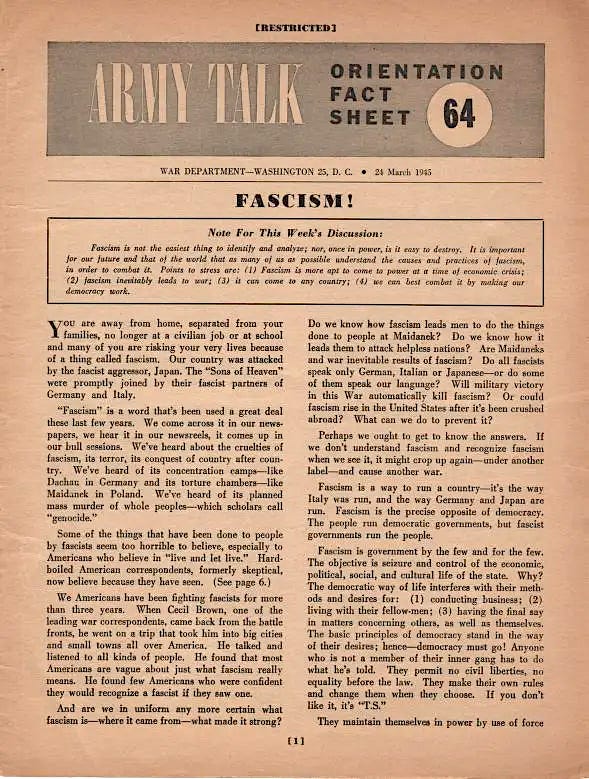
The assault on American unity never ceases. Last Friday, Heather Cox Richardson, a Boston College Historian and author, reminded her 2.7 million Substack readers of a time not so long ago that fascism threatened our nation’s unity. When the great public hero and celebrity Charles Lindberg became the charismatic spokesperson for the America First Committee in 1940-1941, the allure of Nazi fascism was spreading across the country. Even after Germany capitulated in May 1945, the threat of fascism continued and was menacingly apparent in the terrorist campaigns against returning Black GIs by the Ku Klux Clan and the witch-hunts directed by Wisconsin Senator Joseph McCarthy against prominent American citizens from 1950-1954. In the face of these attacks on American unity, Richardson recounts how the U.S. Army published a pamphlet in 1945 to educate soldiers about the deceptive allure of fascism. The pamphlet, titled “FASCISM!,” recognized that the occupation troops in Europe were far away from home, lonely, and susceptible to fascism’s enticements. The pamphlet reads, “The people run democratic governments, but fascist governments run the people…and once in power, fascism is not easy to destroy.” Going further, the Army handout describes fascist leaders:
‘They make their own rules and change them when they choose…. They maintain themselves in power by use of force combined with propaganda based on primitive ideas of “blood” and “race,” by skillful manipulation of fear and hate, and by false promise of security. The propaganda glorifies war and insists it is smart and ‘realistic’ to be pitiless and violent.’
Those words hit a little too close to home these days. Rather than issue a broad, general warning about how fascism threatens democracy, the pamphlet goes on to enumerate three strategies fascists use to gain adherents and weaken a republic:
First, fascists work to divide the nation, pitting religious, racial, and economic groups against one another. They use a “well-planned ‘hate campaign’ against minority races, religions, and other groups.” Consider the current administration’s constant scapegoating of immigrant populations, denigrating of the rival political party and its leaders, vilifying any who offer opposing opinions, and the relentless legal and physical threats. Texas Congressman Wesley Hunt characterizes the persistent brutalism of the Trump government in his justification of the killing of Renee Good, an unarmed, stay-at-home mother of three in Minneapolis:
‘The bottom line is this: When a federal officer gives you instructions, you abide by them and then you get to keep your life.’ (If that sounds more like Heinrich Himmler giving instructions to the Gestapo than an American congressman representing his people, you comprehend the magnitude of the threat that our democracy is under.) (Goldberg, NY Times)
Second, fascist governments refuse cooperation with other nations. “In place of international cooperation, the fascists seek to substitute a perverted sort of ultra-nationalism which tells their people that they are the only people in the world who count. With this goes hatred and suspicion toward the people of all other nations.” To that end, this year the president has backed out of thirty-one United Nations organizations and thirty-five international associations to which America has long been a leader and a contributing member. Also, we should note that the current administration has abdicated its role in international cooperation because it wants no checks on its abuse of the environment or its exercise of power. Stephen Miller, the White House Deputy Chief of Staff, brazenly illustrated the latter in a CNN interview on January 5:
‘We live in a world in which you can talk all you want about international niceties and everything else, but we live in a world, a real world that is governed by strength, that is governed by force, that is governed by power. These are the iron laws of the world that have existed since the beginning of time.’ (Brooks, NY Times)
With advisors such as Miller, is it any wonder that when asked by NY Times reporters on January 8 if there was any limits to his global powers, the president answered: “Yeah, there is one thing. My own morality. My own mind. It’s the only thing that can stop me,” (And all this time I thought we were a nation of laws.) (Sanger, NY Times)
Third, fascists shrink the world down to two choices. In the years surrounding WWII, the choice was either to be a fascist or a communist — the version of the latter was on bold, horrific display in Stalin’s Russia. Today in the United States, the choice being proffered by the current administration is either to be pro-MAGA and therefore a “patriot” or risk being classified as a second class citizen. Last week, in fact, the president announced he is withholding $10 billion in social safety net funding from five Democratic states — California, Colorado, Illinois, Minnesota and New York. The federal grants are issued to fund childcare for low-income working families and assistance to purchase diapers, food, and clothes. The president justified his action by citing fraud concerns in the states. The truth, of course, is that a majority of individuals in those states are on the “wrong team.”
Cruel partisan discrimination on a state by state scale has not been experienced in the U.S. until this administration took office. It is as if the Constitution and the Declaration of Independence have been mothballed. Yet Americans will eventually wake up to the threat of this. Of all people, we know that we must keep a foot in our revolutionary past to remember who we are and to insist we continue work to for a more perfect union.
SOURCES
Richardson, Heather Cox, “Letters from an American,” Substack, Jan. 9, 2026.
Brooks, David, “The Sins of the Moderates,” NY Times, Jan. 9 & 11, 2026. https://www.nytimes.com/2026/01/09/opinion/trump-niebuhr-classical-liberals.html?
Goldberg, Michelle, “No One is Safe From Ice,” N Y Times, Jan. 8 & 11, 2026. https://www.nytimes.com/2026/01/08/opinion/renee-good-minnesota-shooting-ice.html?
Patella Michael F. The Gospel According to Luke, Collegeville, MN: Liturgical Press, 2005.
Sanger, David E.; Pager, Tyler; Rogers, Katie; Kano-Youngs, Zolan, “Trump Lays Out a Vision of Power Restrained Only by ‘My Own Morality,’ NY Times, Jan. 10, 2026. https://www.nytimes.com/2026/01/08/us/politics/trump-interview-power-morality.html?
PHOTO CREDITS
Our daughter Catherine Grace on a happier day, surrounded by her brothers John & Clay and her cousins Rachel & Carey
C.S. Lewis, Wikipedia
The Supper at Emmaus, Matthias Stom, 1635, Museo Nacional Thyssen-Bornemisza, Madrid
Army Talk Fact Sheet 64: FASCISM!, Open Culture, Mar. 24, 1945
Thanks, Pat., especially for sharing the blessing that Catherine Grace’s burial turned out to be for you and Kay and your extended family and friends. God is good, indeed. Your blog is always thought-provoking. Thanks also for reminding me of my “amphibian” status and the need to balance word and sacrament. I’m reminded of something someone said in a sermon: “We’re not okay just the way we are.”