
Fall Books 2025
A Varied Nine Book Array


Dear Friends of the Letter,
Amongst these two historical fiction novels, four books for young adults, a western memoir, a sci-fi Fantasy, and a collection of ancient Japanese poetry — you are likely to find one book to your liking.
I should add that the two by Geraldine Brooks are exceptional. At the same time, I was extremely impressed by the quality of young adult fiction that is being written for our teenage children and grandchildren.
And if you are entranced by the West, as I have been since childhood, you will love Will Grant’s memoir about retracing the route of the Pony Express on horseback — no small feat!
Take up a good book and enjoy a better November!
Your brother in the Great Adventure, Patrick
TWO FROM GERALDINE BROOKS
Geraldine Brooks is widely known as a historical novelist “who fills in the gaps.” She comes by that definition for two reasons: For one, she writes about aspects of our world and our national history that are largely overlooked. For another, her heroes are rarely numbered amongst the notables of the age but instead proceed from the ranks of the working class.
Brooks’s work is celebrated because of its historical accuracy. Working fifteen years as a foreign correspondent, first for her native Sydney Morning Herald and later for the Wall Street Journal, she covered wars in the Middle East, the Balkans, and Africa — even being captured by Nigeria’s notorious secret police in 1994. Through the Journal’s efforts along with a group of implacable Nigerian nuns, she was later released but immediately deported. During those harrowing years reporting in active wars zones and amidst despotic regimes, Brooks became increasing attuned to the nameless people who rise up with resilient courage, even in the midst great carnage and suffering surrounding them.
When interviewed by The Harvard Review in 2019, Brooks readily admitted that her mother remains her single greatest influence. During the 1960s, in the face of great scrutiny, harsh rebukes, and nasty threats, her mother stood up for mistreated minorities in Sydney. Brooks learned from her that fear is the enemy of truth. Quoting her mother, she said, “The minute you are afraid to do something, that’s when you do it.” Brooks added that her mother “really understood the corrosive nature of fear.” It is not surprising that Brooks’s heroes always work against the unrelenting pulse of “corrosive fear” surrounding them.
Year of Wonders, by Geraldine Brooks
Fear permeates her novel, Year of Wonders, for it takes place during the Great Plague in England (1665-1666). Brooks and her late husband, Tony Horowitz, also a Pulitzer Prize winner, were hiking in England when she stumbled upon the grave of Catherine Mompesson, the wife of the Reverend William Mompesson, who was the vicar of Eyam a small village in the Derbyshire region of England during the years of the plague. Intrigued, she investigated further to discover that Catherine Mompesson, resisting the fear encompassing them, succumbed to the plague because she refused to leave her husband’s side during the worst year of the bubonic plague in Eyam. In 1666, the people of Eyam quarantined their village to safeguard others in nearby towns and hamlets. During that single year, 260 of the 800 residents of Eyam perished from the disease.
To write this novel about the bubonic plague or “Black Death,” as it came to be known all over Europe from the 14th century onward, Brooks did extensive study of 17th century England. She consulted historical records, medical texts, and she also immersed herself in the social history of the time, including books on herbal medicine, midwifery, and even witch trials, which emerged in the climate of increasing fear. Furthermore, she studied the journals and sermons of Church of England clergy serving small villages like Eyam at that time.
While she may have been initially drawn to Catherine Mompesson, who becomes Elinor Mompellion in the novel, Brooks’s heroine is the Mompellion’s servant “girl,” the young widow Anna Frith. Her two boys, aged three and five, are early victims of the plague, and in her consuming sadness, Anna declares, “God warns us not to love any earthly thing above Himself, and yet He sets in a mother’s heart such a fierce passion for her babes that I do not comprehend how He can test us so.” Anna is no “straw person,” her deep sorrow and haunting losses follow her throughout the story, yet they do not keep her from selflessly extending herself to others.
Drawing from a latent reservoir of strength, Anna gathers the determination to learn midwifery and herbal cures so that she can effectively nurse her neighbors — especially since they have been abandoned by all the physicians and landed gentry. In time, Anna draws close to Elinor, the vicar’s wife, who opens the cavernous world of books to her. “When she had discovered that I hungered to learn, she commenced to shovel knowledge my way as vigorously as she spaded the cowpats into her beloved flower beds.”
Pushed to her limit of endurance and emotions, Anna continues to serve the village, even after her beloved Elinor dies and her husband, the Rev. Mompellion, frozen in the throes of personal sorrow, turns his back on his parish. Through Anna, the reader explores the enmity between the Puritan and Anglican theologies in the Church of England in the 17th century, the corrosive superstitions that led to witch hunts and murder, the indifference of the upper classes to the plight of their working-class neighbors, and the misogyny that lingered even amongst those considered enlightened in that age. In the end, it is Anna who exemplifies the resilience of the human spirit and the ardent love for one’s neighbor even when her religion betrays her, hope evaporates, the darkest cruelty is employed, and she is forced to leave all that she has known and loved.
March, by Geraldine Brooks
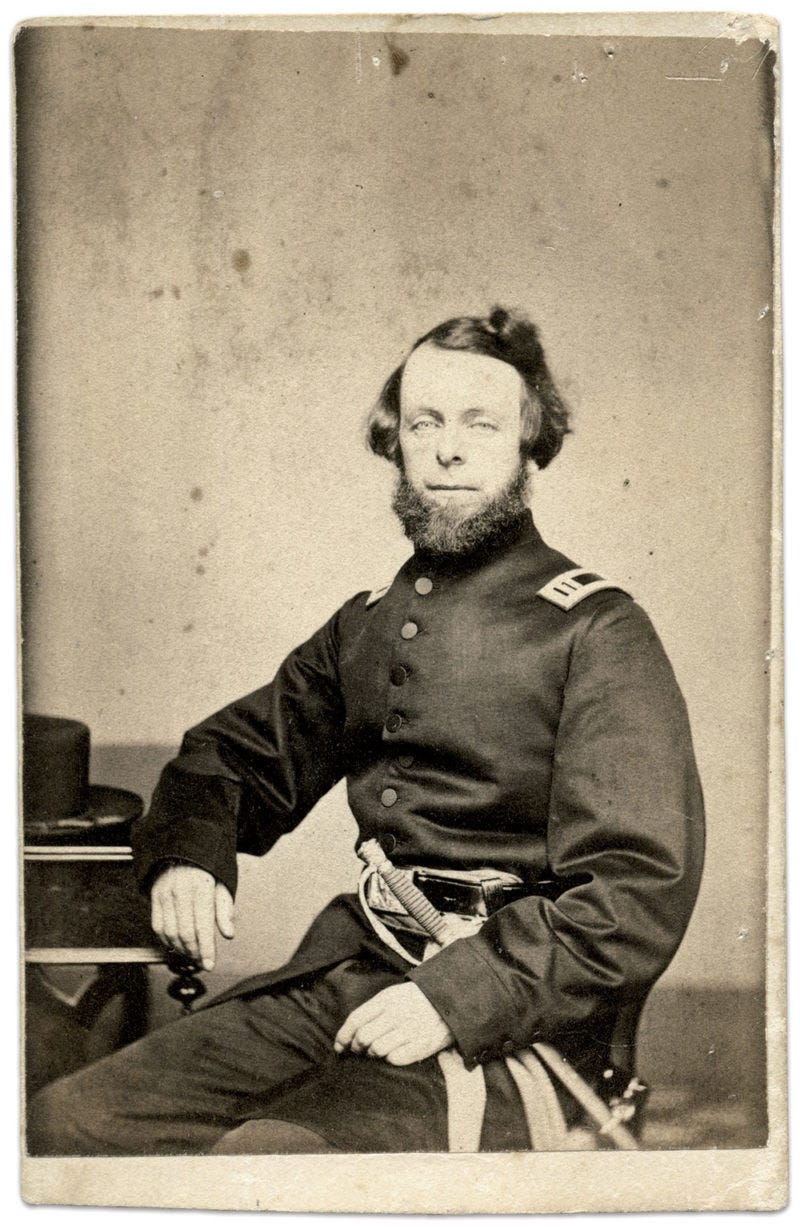
Overcoming fear also drives the plot of Geraldine Brooks’s Pulitzer Prize winning novel, March. The book imagines the wartime experience of John March, the abolitionist father of the Little Women in Louisa May Alcott’s 1868 classic novel set in Concord, Massachusetts. Alcott’s book examines the changes that occur in the lives of Meg, Jo, Beth, and Amy, as well as in their mother, Margaret March —better known as Marmee, during the long years of the Civil War. The father is mentioned only in the girls’ letters and casual conversations in Alcott’s novel. He appears once in the novel, and that is when he comes home to recover from an illness. Alcott’s book is firmly centered on the five March females — not on John.
Geraldine Brooks’s novel, published 137 years after Little Women, focuses on the missing husband and father. Here, it should be noted, that both Little Women and March report much of the actual history of the Alcott family in Concord during the fear and deprivations of the Civil War. The father, Bronson Alcott, was, in fact, a radical abolitionist, pacifist, and vegetarian; however, he was sixty-one when the war broke out and would have been unable to serve. Bronson’s alias in March is significantly younger, but nevertheless somewhat old for military duty when he signs up to serve as a Union chaplain.
Brooks’s novel begins on a plaintive note of mystery. March’s unit is frantically retreating in the Battle of Ball’s Bluff in Leesburg, Virginia. The battle was a near massacre. The Union Army suffered 1,000 casualties in the engagement and 700 others were captured. When March finally regroups with the remnant of the Union forces at a dilapidated mansion, he realizes that he has been in the house previously. Years before when he was a teenager, he was earning money as a peddler, selling goods from northern industries to isolated plantations in the South. He was welcomed warmly by the then prosperous family of this plantation, and March remained with them for many weeks. He was initially seduced by the gentility of their lives, and even began to believe their assertion that slavery could be a force for good. The fog of his seduction dissipates when he is forced to watch the cruel, disfiguring scourging of a young, handsome Black woman — a woman for whom he has developed strong feelings.
Throughout March’s wartime service, he attempts to protect the five “women” back at home with cheerful, optimistic letters from the battlefront. He not only omits the truth about the dreadful war but he hides his dark and conflicted feelings — to include those of a sexual nature. Believing he is part of a noble cause, he is repeatedly rattled by the overt racism of his fellow Union soldiers. Furthermore, March does not report how the gruesome battles disfigure men both in body and soul. None of them will return as the men they once were.
Eventually, March’s commander, furious at his chaplain’s obsessive preaching to abolish slavery and uphold the humanity of Black slaves, reassigns him to work at an experimental farm run by freed slaves on the Sea Islands of South Carolina. While March’s first months there are near idyllic, the farm is eventually overrun by Confederate forces and the Black workers, whom March has come to admire and care for, are slaughtered or pressed back into slavery. March falls critically ill at this point and is tormented by regrets that he did not do more to save his friends.
Through the heroism of a Black slave girl who had her tongue cut out by her owners, March is taken to Washington, DC for treatment. His recovery is far from certain, even after Marmee arrives to nurse him. He survives, but he is far from whole when he finally arrives back in Concord. Like so many of our modern wartime veterans from Iraq, Afghanistan, and Vietnam, he cannot escape the horror of what he has experienced.
Brooks was inspired to create John March in 1992 when she and her husband moved from overseas and landed in Waterford, VA. Not long after they moved into their antebellum home, a Union belt buckle was dug up near their well. The local Baptist church still has musket ball pockmarks in its exterior walls. Mostly, however, she was inspired to create March because in the late 19th century, Waterford was largely a Quaker village, and yet the town, filled with pacifists, sent a company to fight for the Union. Reliving the villagers’ experience of that earlier era put flesh on the bones of John March.
The Last Ride of the Pony Express: My 2,000 Mile Horseback Journey into the Old West, by Will Grant
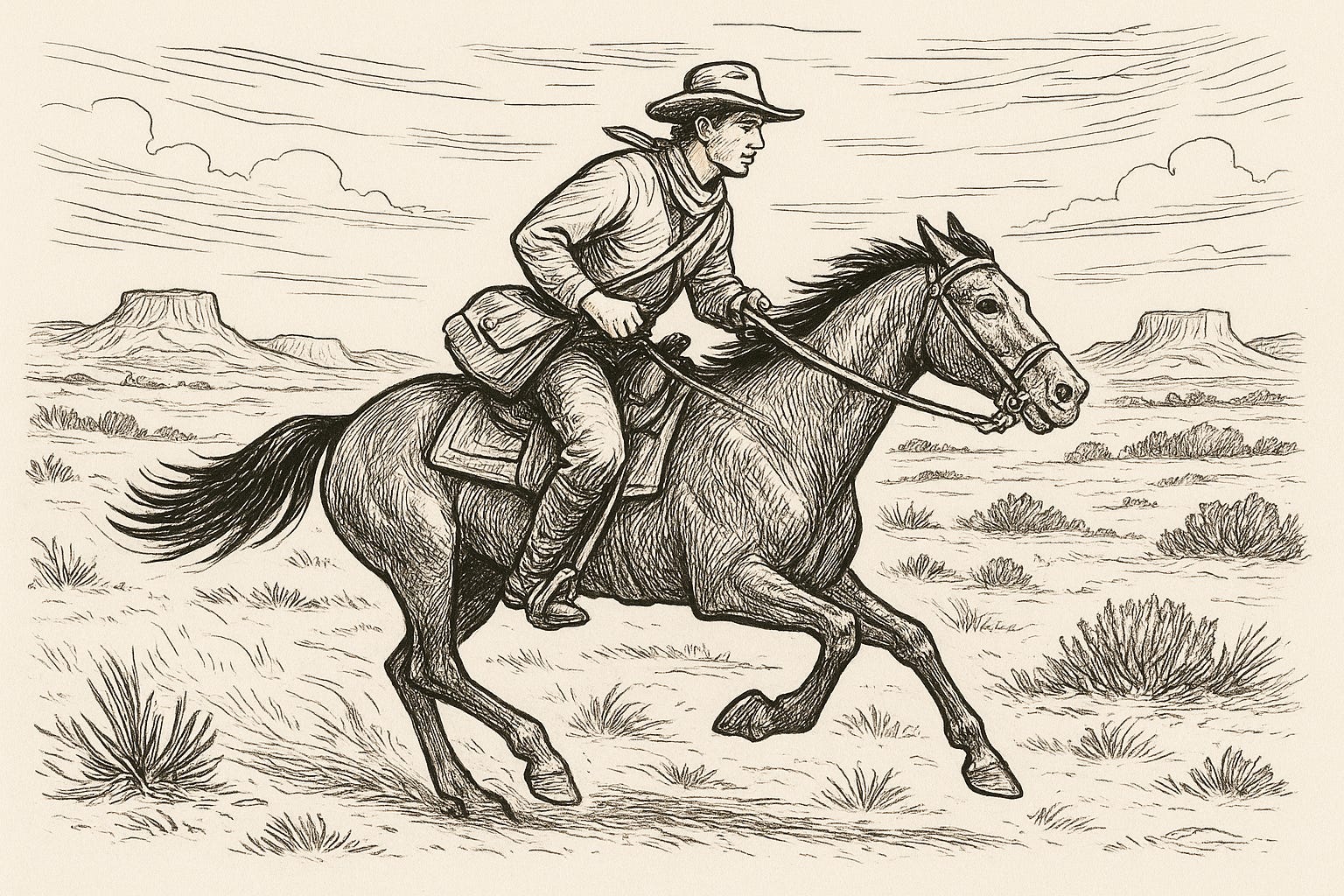
Imagine riding 2,000 miles on horseback from Madrid to Moscow in Europe or from Sydney to Perth across Australia. That was the distance the Pony Express riders covered thirty-four times per month, riding from St. Joseph, MO to Sacramento, CA. They rode the 2,000 mile east-west route seventeen times each month and the 2,000 mile west-east route on their return trips an equal number of times — for a total of thirty-four cross country dashes. Each rider would ride at a fast trot or canter for 100 miles, changing horses every ten to fifteen miles, before they would handover the mail satchels with the next rider. The rider would rest until it was time for him to relieve the exhausted rider heading in the opposite direction. No wonder recruiting advertisements for the Pony Express purportedly read:
Wanted: Young, skinny, wiry, fellows, not over eighteen. Must be expert riders, willing to risk death daily. Orphans preferred. Wages $25 per week.
Due to the prohibitive expense to operate the Pony Express, it was abruptly halted after its short run from April 3, 1860 to October 26, 1861. The service just couldn’t carry enough pieces of mail to pay the bills. Nevertheless, as author Will Grant states, “It was the greatest display of American horsemanship to ever color the pages of a history book, based on mileage, number of horses, and rapid execution.”
Ironically, horseman Will Grant became even more enamored with the Pony Express after experiencing horse culture overseas. He traveled to Mongolia in 2012 to race 900 miles across the steppes in the historic Mongol Derby. And in 2019, he flew to Kyrgyzstan to play Kok Boru, the most violent game on horseback on the planet. The game was being played in Eurasia 750 years before the United States was founded. Grant chronicles his experience in his Outside Magazine article, “Blood, Sweat, and Headless Goats: Kok Boru is the Wildest Sport You’ve Never Heard Of.” In his report, he tells how he was knocked off his horse and began “peeing blood.” Once returning home and recovering, Grant declared his determination to ride the 1,966 mile frontier trail of the Pony Express:
Any horseman worth his salt wold agree: the Pony Express is an apex of American horsemanship and to trace its course would be nothing short of transcendental. And so I talked myself into it. Some people look for answers in a library; I look for mine between the ears of a horse.
Grant undertakes the historic ride beginning on May 5, 2019 and finishes 142 days later on September 22. He walked his horses over the 2,000 route lest he kill them. In fact, the biggest decision Grant has to make is which two horses to employ for the journey. For months he travels to various ranches to seek horses sturdy enough to make the trek, yet, at the same time, calm enough to deal with traffic and expansive river bridges. He settled on Chicken Fry, a Mexican Horse, and Badger, a Quarter Horse. He chose right because the two accompanied him every step — to include crossing Utah’s vast West Desert and Nevada’s isolated Great Basin Desert. For Grant, however, the loud, busy Midwestern and California cities proved much more difficult riding.
During the 142-day ride, Grant wore out his boots, jeans, shirt, and went through a dozen wool socks. The end of the line was the famous Pony Express statue set in the middle of Old Sacramento State Park. Climbing off his horse, he mused that “It felt like the twilight of a day that was five months long.” However, even after completing the long ride, Grant was stupefied by the sheer magnitude of the daunting accomplishments of those eighty young men and 400 horses:
Fundamentally, I couldn’t quite see how a bundle of letters in a saddlebag could be relayed by horseback from Missouri to California in ten days in 1860. I calculated the number of exchanges, points where a rider would get a fresh horse or hand off the mail to another rider, during one week when the service was running twice weekly in both directions. It was 532 exchanges per week...it represents a massive coordination of man hours, a lot of running horses, and slightly more than 5,500 miles of horseback travel per week.
FOUR YOUNG ADULT NOVELS AND ANOTHER ON THE BORDER OF YOUTH AND ADULTHOOD
I’d like to say that I read four young adult novels in succession to rebut the crazed effort to ban books in school libraries. The truth is more mundane. I was visiting a friend several states away and pulled a book off her shelf to read. The book, Homecoming, by Cynthia Voigt, hooked me by the end of the first paragraph:
The woman put her sad moon-face in at the window of the car. “You be good,” she said. “You hear me? You little ones, mind what Dicey tells you. You hear?” “Yes, Momma,” they said. The woman then turned away and walked off.
Homecoming, by Cynthia Voigt
Homecoming took me back to one of my favorite novels from childhood, The Incredible Journey, by Scottish author Sheila Burnford. The 1961 book follows the 300 mile journey of Luath, a young Labrador Retiever; Bodger, a mature Bull Terrier; and Tao, a Siamese cat, as they make an arduous, seemingly impossible trek across the wilderness of Northern Ontario to return home. I feel myself choking up as I remember the book, for it and Jack London’s Call of the Wild, set me on a lifetime of reading.
Voigt’s novel struck me in much the same way as London’s and Burnford’s books, albeit with human travelers. The four Tillerman children, Dicey, 13; James, 10; Maybeth, 9, and Sammy, 6, want nothing more than to get home. The only problem is that they no longer know where home is for them.
The novel opens in the parking lot of a large shopping mall in an unnamed city. All four children are left in a old station wagon, when their mother, Liza Tillerman, disappears into the mall, saying nothing more than to mind big sister Dicey. Liza drove the children part of the way to Bridgeport, CT before she mysteriously abandons them. The children wait for their mother throughout the entire day and night. Realizing their mother will not return, they set out on a 150 mile journey to Bridgeport, CT to find their great aunt Cilla, whom they have never met and only know through a yearly Christmas card.
Dicey’s courage and innovation enables her to lead her three siblings through rolling rural landscapes and confusing and dangerous metropolitan cityscapes. Having to scavenge or work for food, find safe places to sleep, and navigate across unknown terrain, are Herculean tasks for a 13-year-old.
After several weeks of travel, they arrive in Bridgeport, only to find that their great aunt Cilla has recently died. Eunice, Aunt Cilla’s daughter, lives in the home and reluctantly agrees to take in the children. Her invitation is complicated by her lifelong desire to become a nun. Furthermore, after the children live with Eunice for a time, she, along with her priest and the nuns at the Roman Catholic school where the four are enrolled are intent on sending James to a school for children with behavioral disorders and Maybeth to one for cognitively challenged students.
Learning of their plans, Dicey, ever-stalwart defender of her brothers and sister, plans a daring escape from Connecticut to the Eastern Shore of Maryland. She recalls they have a grandmother living on the Eastern Shore about whom their mother refused to discuss. This second journey is more desperate than the first, as Dicey is terrified of being apprehended and two of her siblings taken from her, especially when the authorities learn that their mother has been institutionalized in a psychiatric hospital in Boston and is unresponsive. A modicum of hope appears for the beleaguered Tillerman children when they are offered a short stint with the circus!
The overarching theme of Homecoming is “belonging.” Having lost their parent, will the Tillerman children ever be welcomed by another adult? After the half-welcome extended by Eunice, they have their guards up. At the same time, the novel explores the children’s increasing attributes of resourcefulness and resilience. All four children adapt to the rigors of their journey, yet Dicey rises well beyond the expectations of a young teen. That is the primary reason this is an excellent selection for pre-teen and young teenage youth — especially girls. At the same time, the book offers a first-class adventure story.
Dicey’s Song, by Cynthia Voigt
Seven novels make up Voigt’s Tillerman Cycle. Dicey’s Song is the second and the only one to win the coveted Newberry Medal. I was so taken with Homecoming, the first book in the cycle, that I borrowed a copy of Dicey’s Song from the San Antonio Library. I should add that Kay and I have one granddaughter, and we are always on the lookout for books that will both captivate and challenge her.
When the novel opens, Dicey is confronted with a very different test than shepherding her siblings hundreds of miles through unknown territory. Now, she must learn to let go. Her fiercely independent, outspoken, and thoroughly unconventional grandmother, “Gram,” has taken the four of them in to her ramshackle farmhouse. All four are enrolled in the local schools and Dicey finagles an afterschool job. Nevertheless, Dicey keeps her guard up and cannot completely settle in — even though Maybeth and Sammy are receiving the additional help they need at school and Gram’s high walls of aloofness are gradually dissolving.
Dicey, believing the situation with Gram can only be temporary, will not allow herself to make friends. However, her brilliant black classmate, Wilhelmina, and Jeff, an attractive musician and songwriter a year of so older, keep approaching her no matter how many times she rebuffs them. Also, quite unexpectedly, Mr. Isaac Lingerle, the music teacher at Maybeth’s school offers to give his young student free piano lessons. Mr. Lingerle, with his ponderous bulk, becomes a fixture at Gram’s house and makes it feel more like home for the children. What makes Dicey feel the most at home, however, is restoring an old sailboat, which has sat unused in Gram’s barn for scores of years. It becomes a symbol of belonging at Gram’s house, which sits on the waterway winding through the Eastern Shore.
Like Homecoming, a journey significantly figures into the story. Gram and Dicey must make the trip to Boston, a city neither of them has ever visited, because they have received word that Liza Tillerman, the children’s mother, is precipitously failing. At the hospital, Dicey witnesses the great love Gram has for her daughter — even though the two were estranged for many years. Furthermore, the long journey binds Gram and Dicey together as sojourners traveling toward a new beginning. As soon as the two arrive home, Gram files adoption papers for the children. The four Tillermans are finally home.
TWO BY JOHN GREEN
I thought I was finished with Young Adult Fiction until I read a review of Everything is Tuberculosis: The History and Persistence of Our Deadliest Infection, by John Green — an author with whom I was unfamiliar. Stuck in this anti-science public health milieu fostered by our Secretary of Health, I was drawn to this title. Green wrote the book after visiting Sierra Leone and becoming friends with 17-year-old TB patient Henry Reider. Henry’s physical development was so stunted by the disease that he looked significantly younger. Getting to know Henry and seeing the devastation of tuberculosis up close, made Green want to study the history and treatment of the disease, as well as calculate the threat of its return.
Fascinated by this story, I investigated further to find that Green had a stable of bestsellers, to include The Fault in Our Stars, which became a $307 million grossing film. What’s more, he is the originator of YouTube series such as the Vlogbrothers, SciShow, Crash Course, and the podcast The Anthropocene Reviewed. Some will know Green through his work on All Things Considered on NPR.
As for Green’s Young Adult Fiction, he is best known for what he terms GreenLit, which is his term for young adult novels that deal with complex human experiences as well as difficult human dilemmas. That is to say, Green’s work is most suitable for older adolescents. Both books I review deal with tragic deaths and teenage sexuality.
Looking for Alaska, by John Green
A party starts the novel, a going away party. Miles Halter has elected to leave his quiet high school life in Florida to attend his father’s boarding school, Culver Creek Preparatory School outside of Birmingham, AL. His mother insists on throwing the party. Miles warns her that no one will attend, for he has no friends. She presses on. Two awkward Sci-fi nerds finally show up late, only to ignore Miles, speak solely to his parents, and leave within the hour. The parents and Miles sit together on the sofa and eat a mixing bowl full of artichoke dip while watching a movie.
The next day the parents drive Miles to Culver. Obsessed with famous persons’ last words, Miles is seeking what François Rabelais uttered with his dying breath — “The Great Perhaps.” Miles’s parents no sooner get him ensconced in his dorm room and turn around for home than the 16th century French writer’s prophecy comes true for Miles. His roommate arrives, christen’s Miles “Pudge,” and informs him that he is Chip Martin, but henceforth will be known only as “The Colonel.” Within the hour, The Colonel introduces Pudge to the two others in their quartet, Takumi Hikohito, a Japanese American with a talent for composing and singing rap songs, and Alaska, the voluptuous, intelligent, introspective leader of the group…and with whom Pudge falls hopelessly in love at first sight.
Green accurately describes boarding school life, as he attended Indian Springs School, seventeen miles south of Birmingham. In the absence of public school cliques and well-defined pecking orders, small boarding schools tend to be more eclectic in the way students sort themselves out. Pudge has ended up in a foursome that breaks school rules daily and pulls off the most memorable pranks in the history of Culver…to include substituting a male stripper for an esteemed annual lecturer!
The second half of the novel takes a dark turn with Alaska’s gruesome death. The remaining three grieve her death and merely sleepwalk through the spring semester. Finally, they decide to investigate how Alaska died and why. The Colonel, Takumi, and Pudge all have reasons to feel partially guilty for Alaska’s sudden death. Green’s artistry is revealed in this part of the novel, as he leads the reader through the tortured emotions and frayed relationships that follow trauma. Alaska, also enamored by last words, introduced the quartet to Simón Bolívar’s last words: “Damn it. How will I ever get out of the labyrinth!” Those words become the remaining trio’s maxim as they seek clarity and a return to life.
This is an exceptional book for older teens as they seek a deeper meaning for life. “The Great Perhaps” is a symbol of every young person’s quest. Also, Green shows his readers how individuals retain significant mystery, no matter how intimate their relationships. In the end, Alaska’s life and death could not be fully uncovered. Above all, forgiveness is the nucleus of the novel. The Colonel, Takumi, and Pudge realize they can only go on if they forgive each other. Growing up is unbearable in a graceless universe!
Turtles All the Way Down, by John Green
At a time when mental illness has beset so many of our youth, Green’s novel addresses it in a graphic and very personal way through his protagonist, 16-year-old Aza Holmes. Aza suffers from a severe obsessive-compulsive disorder where she fixates on the 40 trillion bacteria inhabiting her body — every human body, in fact. Her phobia further manifests itself in her extreme fear of hospitals, antibiotics, and an irrational fear of contracting Clostridioides difficile, commonly known as C.diff. Green is so good at getting inside of Aza that her long inner-monologues surrounding these bouts of fear become agonizing at times for the reader. At least they did for this reader.
The plot of the novel centers on the disappearance of Russell Pickett, a billionaire developer under criminal investigation for a succession of crimes, to include high-level bribery. He is intensely disliked in his hometown of Indianapolis for failing to complete an important drainage project along the west fork of the White River, which frequently floods, destroying working-class homes and small businesses. A reward of $100,000 has been offered for information regarding Picket’s whereabouts. Aza and her best friend Daisy Ramirez are intent on collecting the reward to help fund their college educations.
Early in the novel as the two strike out on their investigation, Aza runs into Davis, Russell Picket’s oldest son. This reignites a childhood romance the two shared at “Sad Camp,” a summer camp for children who have suffered the loss of a parent. Aza’s father died when she was younger as had Davis’s mother. The romance flourishes until Aza begins to obsess about the number of microbes she ingests from Davis when they are kissing. Even sitting next to him begins to fill her with irrational fear.
Serendipitously, Aza puts together the puzzle of Pickett’s disappearance. Her meticulous memory coupled with a nighttime art show held downtown by the river, leads her to deduce his hideaway. The epiphany does not save her relationship with Davis, but moves Aza slowly along toward recovery.
Friendship is at the heart of this novel. Aza’s and Daisy’s relationship is both colorful and unassailable. Additionally, Aza’s relationship with her now widowed mother is one fraught with the expected tension between an adolescent and her parent, yet they maintain a healthy communion of give and take. Thirdly, Aza’s relationship with Davis bespeaks respect and understanding, even though their romance is shattered on the shoals of Aza’s phobias.
Again, I would recommend this book for older teens, and I consider particularly beneficial for teens battling minor mental illness or depression. Aza could become an understanding partner on their journey.
ON THE BORDER OF YOUNG AND NOT SO YOUNG
The Book that Wouldn’t Burn, by Mark Lawrence
When asked whether his bestselling novel was written for young adults or an older audience, Mark Lawrence responded, “It is a fantasy novel about books, memory, and love — written for adults who remember what it was like to be young.” At 556 pages, The Book that Wouldn’t Burn is a sprawling love story set in a boundless library carved out of a side of a great mountain a millennia or more ago and is filled with volumes in so many languages that many are no longer translatable. What’s more, the labyrinthine library’s architecture is replete with secret passages into expansive walled-off chambers, portals into different time dimensions — past and present, and uncountable collections of lost histories. Quite frankly, I needed a younger, more agile mind to picture the library’s architecture. The composition of the library is further complicated by the fact that it is not merely a storehouse for books but a living entity that is continually evolving.
In truth, that is exactly where Lawrence is taking his readers — even a 71 year-old. The library represents the human mind and the collective memory of civilization. Lawrence’s warning to his readers is that those in power selectively retain the histories that support their enterprises and reject the episodes from history that call their actions and assumptions into question. Such selective memory always leads to destruction. (A fair warning for those in power today.)
Into this maelstrom of power, war, and convenient truths, are two individuals who spend their lives in the immense library. Although the two are separated by the architectural geography of the library as well as by time, they meet through one of the portals and fall in love. Like a fantastical rendering of Romeo and Juliet, their love is ill-fated, for it represents the long held historical hatred of their two “people.” Lawrence, acting the part of Shakespeare’s Prince of Verona, warns his readers that accumulating great wisdom without developing deep relationships leads only to destruction.
POETRY’S WINDOW INTO THE PRESENT MOMENT
Japanese Death Poems: By Zen Monks and Haiku Poets on the Verge of Death, compiled by Yoel Hoffmann

The week that our daughter died, I received a small parcel from a new friend in Maine. My friend, an Asian Christian, sent me a book that had previously helped her through the death of a loved one. At first, I was taken aback, Japanese Death Poems! Yet after our extended family departed for home, I read Hoffmann’s excellent introduction to, what was for me, a previously unknown genre. Drawn in by his comprehensive explanation, I read representative selections of these three-line, seventeen syllable poems. These poems familiarly known as haiku, and some other sparse forms known as jisei, are terse, artistic testimonies written by Zen monks, samurai, and Japanese nobility on the verge of death. The authors not only face death with calm acceptance but with a greater awareness of the creation that surrounds them. In short, they provide readers a window into the present moment. Here are some examples from the over 300 haikus included in the text:
On a journey, ill:
my dream goes wandering
over withered fields.
Matsuo Basho (1644–1694)
Yesterday, it was hibiscus.
today, my life is
morning glory.
Shohaku (Died in 1779)
Clear sky—
the way I came by once
I now go back.
Gitoku (1754)
Contemporary Buddhist Jaira Jewel Lingo explains the value of living in the present moment:
Life is unfolding in ways we can’t always understand when we’re right in the thick of it…. Some things are going to happen that cause suffering. Some things are going to bring us joy. Some things will happen in our lives that we want. Some things will happen that we don’t want. There’s tremendous freedom that can come from learning to turn towards all of it with an open heart, rather than pushing away… This teaching ‘present moment, wonderful moment’ helps us to say that if we can dwell in the present moment and just be with this now, not project into the future ... then we can bear it.
Reading Lingo’s words, I recalled what Jesus said about living in the present moment, ‘Therefore do not worry about tomorrow, for tomorrow will worry about itself. Each day has enough trouble of its own’ (Matthew 6:34). Thanks to my friend in Maine, a procession of ancient Japanese poets, and a Buddhist scholar I’ve never met, I am living with my nagging sorrow but with eyes more attuned to the unfolding day.
PHOTO CREDITS
Person reading with cup of coffee, by Priscilla Du
The Rev. John Calvin Kimball, Chaplain with Massachusetts Militia and outspoken abolitionist, from the C. Paul Loane Collection
Thanks, as always, Pat for these recommendations. As you know, I’ve enjoyed reading so many of the titles you’ve endorsed over the years (as well as a number of them, March being the latest, that you’ve just gone and kindly given me a copy). I’m adding Year of Wonders and The Last Ride of the Pony Express to my “Books to Read” short list, for sure. Again, thanks!
The only one I’ve read is March, and I really enjoyed it. Got a couple of good ideas on others from your post ( bubonic plague etc).