
Courage
Amos 1:1-15 Leaving Home


Dear Friends of the Pilgrim Letter,
After writing thirty-nine essays on the Gospel of Luke beginning on January 8 of last year, I am breathing a deep sigh of relief. My love for Luke is undiminished, but I am glad not to live in such close quarters with him for awhile.
In this Letter, I turn my attention to the Prophet Amos, whose book I am teaching at two Bible studies at St. Boniface in Comfort, TX this winter. The extraordinary interest in the curmudgeonly prophet at first surprised me, until I realized Amos was a man of the land, perhaps even a rancher, which indelibly connects him to the people in the Texas Hill Country parish.
What distinguishes prophets, their lives, and their writing will be a theme woven throughout these essays. For the prophet, courage was foundational. Amos exemplifies the intrepid nature of the Hebrew prophets in spades.
I compare Amos’s courage to that of the writers of the Declaration of Independence, and, at the same time, view their document as prophecy urgently speaking across two and a half centuries to Americans today.
Thank you for joining me on the Great Adventure, Patrick
STARTING OVER
Kay and I were enjoying lunch at a Kerrville, TX restaurant, luxuriating in ambrosial plates of turnip greens, pintos, and cornbread. I am surprised the four people at the table next to us did not complain about my repeated primordial groans of delight. For two Alabamians, beans and greens qualify as food for the gods.
In mid-chew, I looked up from my plate to see Melody, our thirty-something waitperson, attending to an elderly woman seated in the middle of the restaurant. The woman was dressed in a soiled t-shirt and cutoff sweatpants that exposed the blue and black bruises running down her legs. Melody had carefully packaged up the woman’s leftovers and had fetched her a large styrofoam container of iced tea. Yet Melody, in no way, was merely humoring the woman or rushing her out the door. I was taken aback by how tenderly she spoke to the careworn woman, as if she was the only person in the crowded restaurant. (Later Kay told me that another diner in the restaurant anonymously paid for the lady’s meal.)
When Melody returned to our table to refill my iced tea glass, I ventured my perennial question, “Did you grow up in Kerrville?”
“Oh, no sir, my husband and I are from Corpus Christi. We just decided to come up here.”
“Was your husband offered a job or something?”
“No, we just hopped in the car and drove.”
“Do you have family in Kerrville?”
“My uncle and aunt are Pentecostal preachers in town.”
“So what made you move?”
“We were into some bad stuff — very bad stuff. If we did not get out of Corpus, we were going to be hurt or hurt somebody. We have a little boy, you know.”
“Did you tell anybody your were leaving or anybody up here that you were coming?”
“No sir. The three of us just got in the car, drove through the night without stopping, and knocked on my aunt’s and uncle’s door later that night… Actually, it was early the next morning.”
“They took you in?”
“Changed our life. We live for Christ now. Everything has changed. Everything.”
I then understood the patient kindness Melody extended to the disheveled elderly woman. She was treating her the way she and her battered family had been treated. Melody was caught up in the miraculous circle of grace. Even so, it took great courage for her to step into that circle.
LEAVING WHAT YOU KNOW FOR WHAT YOU DON’T
Amos 1:1-15
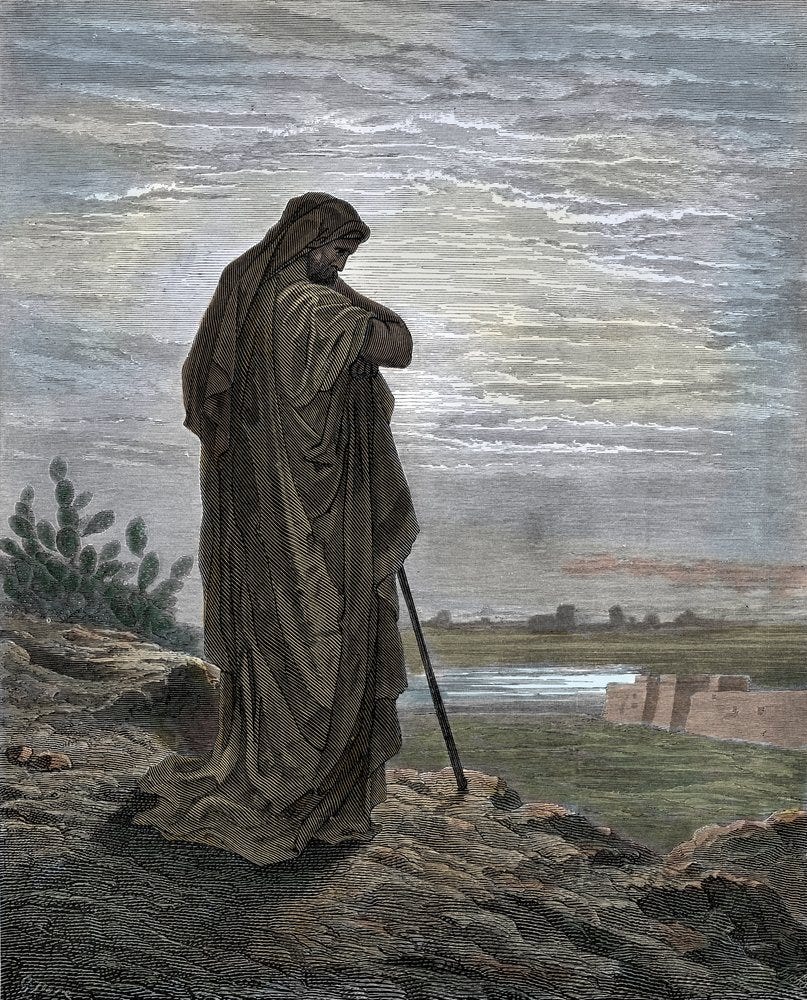
Our lunch break in Kerrville coincided with the beginning of a study on the Prophet Amos that I was offering at the church. Frankly, I was taken aback by the demonstrated interest in the cantankerous prophet shown by parishioners and some others in the community. Amos is not known for his warm fuzzies; quite the opposite, in fact. I suspect people are drawn to the quarrelsome prophet for the same reasons we are drawn to Abraham, Moses, Mary Magdalene, and Paul. Amos heroically steps out from what he knows to what he does not.
About 760-750 BC, the time when Homer composes his epics The Iliad and The Odyssey in Asia Minor, Amos steps out from his farm in the village of Tekoa, twelve miles south of Jerusalem, to prophesy in Israel’s northern kingdom. Two hundred and twenty years before, the northern part of Israel split from the south in much the same way the southern states of the U.S. seceded from the north during the years of the Civil War. In a show as ballistic as the cannons pointed at Ft. Sumter, David’s unified nation is torn apart in 931 BC. Because ten of the twelve tribes of Jacob, a.k.a Israel, resided in the northern part of the land, the north took the name Israel. The south’s dominant tribe of the two remaining tribes was Judah; therefore, they took that name. Sadly, the nation was not reunified until 1948 AD when the modern state of Israel was established.
When Amos makes the fifty-five mile journey from his farm in the rural south to Samaria, the glittering capital city in the north, he is stepping into a foreign land, and he does so at considerable cost. Amos is no farm laborer. He is a prosperous farmer and livestock rancher. He steps away from his land holdings and livelihood for at least a year and perhaps several years time. Furthermore, God calls him to an unenviable job: As the late Biblical scholar Bruce Metzger noted, “Amos is called to preach harsh words of judgment in a smooth season.” In the 200 years since the kingdoms split apart, Israel experiences immense prosperity, considerable territorial expansion, increased military might, and beneficial regional alliances. The leading citizens and religious leaders declare that their affluence is evidence that God particularly favors them. Amos arrives in their shimmering city to dispel their illusion. He is hardly popular. Despised is more like it. (Metzger, Oxford Annotated)
So why does Amos continue? Why does he remain in the north where he is clearly not wanted and there are pressing needs going untended at his farm? Amos and the rest of the Hebrew prophets are not acting out of ambition or, for that matter, a “sense of call,” as we pastors repeat interminably. No, Amos steps out into the hostile territory of Israel because he feels what God feels. Abraham Herschel, the towering 20th century authority on the prophets, illustrated the intimate relationship between the prophet and God with the Hebrew word yada. Comically popularized on the sitcom Seinfeld — “yada, yada, yada,” the word is actually defined as “knowing; deep attachment to another, or feeling for the heart of the stranger.” According to Herschel, the prophets “felt the heart of God,” the One who is a “stranger” to us. Herschel defines this trait as the divine pathos, a trait that leads the Hebrew prophets to express to the people that God “is not the Remote One, but the One Who is involved, near, and concerned.” Amos, therefore, is drawn to Israel’s capital because he feels what God feels about them, that the nation’s burgeoning prosperity has come at a cost, and the cost will come due with the fearsome Assyrian assault in thirty years’ time. Exploitation of the poor, injustice, empty nationalistic worship, and dependence — not on God — but on martial power grieves the heart of God. Knowing God’s heart that way, Amos courageously steps out of the life he knows and bravely addresses a people he does not know. (Herschel, The Prophets)
Amos’s astounding courage is not a trait he developed. His bravery is driven by his intimate connection with God. The Hebrew term for courage, ometz, literally means “strength” or “heart-strength.” Rabbi Marc Margolius states that “Biblical courage isn’t just physical bravery but a spiritual resilience rooted in God’s presence, a willingness to act despite fear, and a deep inner resolve to do what is right, even when difficult.” Driven by “God’s presence,” Amos intrepidly leaves what he knows to confront those he does not and who do not, in any way, want to hear what he has to tell them. (Margolius, Jewish Learning)
Amos no sooner opens his mouth in Samaria than the people want to run for cover: ‘The LORD roars from Mount Zion; his voice thunders from Jerusalem.’ God in no pussycat. He is a lion roaring His judgment from Jerusalem no less, the site of God’s sacred temple that the Northern Kingdom has deserted. As Amos continues, God goes from being a fierce lion to a searing drought: ‘The pastures dry up, and the grass on Mt. Carmel turns brown.’ Mt. Carmel, a revered sacred site for Israel since that is where Elijah defeated the 450 prophets of Baal, is turning to dust, signifying Israel is under fierce judgment. The people can’t help but recall that Elijah had brought soaking rain to drought parched Mt. Carmel and the region surrounding it 120 years earlier (1 Kgs. 18).
How curious then that Amos does not continue his fiery prophesy by lambasting Israel. Instead, he lets loose on all the kingdoms that surround Israel. Syria, on the northeast, is denounced for their savage cruelty. Philistia, to the east, is decried for its international slave trade. Tyre, to the north of Israel, failed to keep its promises with other nations and broke covenant with them. Edom, at the southeast corner of the Dead Sea, is singled out by Amos for showing no mercy to Israel, even though the two nations are connected by blood, specifically through the twin brothers Esau and Jacob. Finally, Ammon, just above Edom and directly east of Israel, is castigated for it barbarous assaults. When attacking Gilead on the east side of the Jordan River, the Ammonites went so far as to rip open the abdomens of pregnant women.’
In chapter 2, Amos will continue issuing God’s judgment against the two remaining nations surrounding Israel — Moab and the Southern Kingdom of Judah — before taking up the onerous sins of Israel. Why, if Amos is being sent to prophesy against Israel, does Amos begin by judging the kingdoms surrounding them. The answer is that Amos wants to make it clear that God, Yahweh, is no local deity attached as some sort of talisman or good luck charm for the nation of Israel. Not hardly. Yahweh is God over every inch of creation. All nations are subject to His rule. By encircling Israel with prophecies of judgment, he is lighting the fuse for the real fireworks.
The Hebrew prophets use images and nuance to press forward their biting critiques of those to whom they are sent. Their images create word pictures for the reader that are hard to shake, while their use of nuance or subtlety combines shades of meaning that require careful reading akin to reading English poetry. In fact, 70-75% of the writing of the Hebrew prophets in the Bible are verse as opposed to prose. Because it is poetry, the reader must pay attention to every line composed by the prophet lest he miss the deeper meaning of his prophecy. (Prophecy, Society for OT Study)
READING THE FINE PRINT OF THE DECLARATION OF INDEPENDENCE
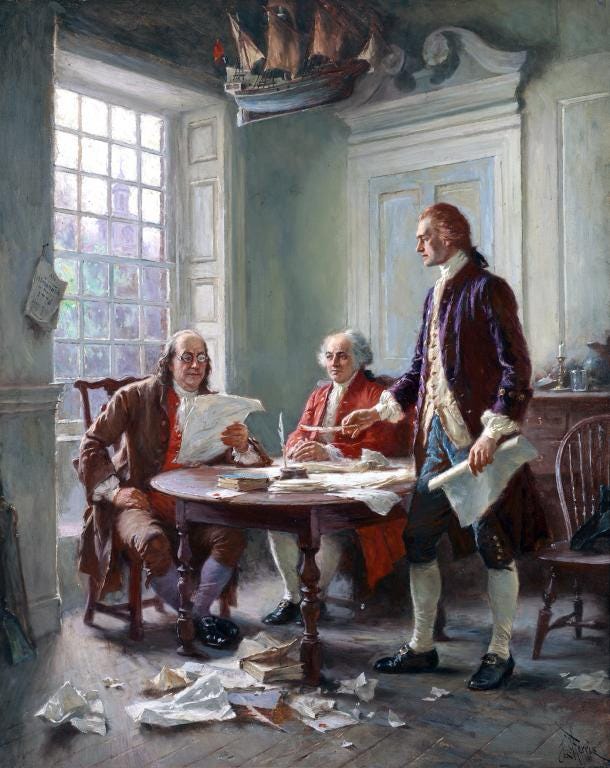
Coming up for air while studying Amos, I read the short volume The Greatest Sentence Ever Written, by Walter Isaacson. Written by the celebrated historian who previously penned the biographies of Leonardo da Vinci, Albert Einstein, Henry Kissinger, Steven Jobs, and more recently Benjamin Franklin, Isaacson wrote this sixty-seven page book about the Declaration of Independence for America’s 250th birthday. My sister-in-law Anita bought copies for each member of her family. Accordingly, once I finished it, I bought thirteen copies for my friends and co-workers. Isaacson specifically examines the Declaration’s greatest sentence— “We hold these truths to be self evident, that all men are created equal, and they are endowed by their Creator with certain unalienable Rights, that among these are Life, Liberty, and the Pursuit of happiness.” The short volume reminds Americans that our nation was founded on enduring values rather than military might or economic expansion, which was a radical break from the monarchial nations spread across Europe and other continents.
In the Appendices of the book, Isaacson includes documents, or in some cases portions of them, that inspired the epochal discourse composed by Jefferson, Franklin, and Adams. Those documents include Thomas Paine’s Common Sense, John Locke’s Second Treatise on Government, Jean-Jacques Rousseau’s The Social Contract, and George Mason’s Virginia Declaration of Rights. The last document in the appendix is the full text of the Declaration of Independence, and for the first time I read it from start to finish. Most of the Declaration is not philosophical but direct, unambiguous charges waged against Britain’s King George III, whom the colonists held responsible for the tyranny they were enduring. Appealing to the timelessness of our nation’s founding document, I have printed a representative sample of the 18th century framers’ listed complaints from the Declaration in bold print followed by corresponding injustices we are presently experiencing under President Trump and his administration in plain type:
He has forbidden his Governors to pass Laws of immediate and pressing importance…till his Assent — Consider the president’s dismantling of state’s alternative energy efforts and destruction of air and water pollution controls. The nearly complete Vineyard Wind project off the coast of Massachusetts is losing $2 million per day due to the administration’s interference. Empire Wind is losing $50 million per week. (Joselow, NY Times)
He has endeavored to prevent the population of these States; for that purpose obstructing the Laws for Naturalization of Foreigners — Consider the administration’s haphazard pursuit of immigrants, regardless of their contributions for the states’ industries, farms, and societies. In Nebraska alone, some meat production plants have cut their output by 30-70%. Furthermore, Nebraska is a state with a rapidly aging population. Aggressive immigrant roundups have curbed the work of schools, hospitals, and construction companies in the state. (Stover, Examiner)
He has made Judges dependent on his Will alone for the tenure of their offices — While that may not yet be true of our nation’s judiciary, it is certainly true of other elected officials, where the threat of “I will primary you” is issued at the first act of resistance or independence by an official.
He has affected to render the Military independent of and superior to the Civil power… and for Quartering large bodies of armed troops among us — Los Angeles, Chicago, and most horrific of all — Minneapolis make the arrival of Red Coats in April 1775 in Boston look tame. (Collins, Minnesota Public Radio)
He has obstructed the Administration of Justice, by refusing his Assent to Laws for establishing Judiciary Powers — Rather than assenting to the laws of our land and preserving the independence of the Department of Justice and the FBI, the president has openly abandoned the impartiality of our nation’s jurisprudence in order to prosecute his political foes. (Cobert, Constitutional Center)
For transporting beyond the Seas those to be tried for pretended offenses — Think on the case of Kilmar Abrego Garcia and untold nameless others who were sent, without trial or hearing, to a terrorist prison in El Salvador. Now literally hundreds of immigrants are being sent to African nations like Ghana, Rwanda, Eswatini, and South Sudan, where most have no history or relationships. (Fischer, Amnesty International)
For cutting off our Trade with all parts of the world — The president has not cut off “trade with all parts of the world,’ but how long will it take to repair our long-trusted trading partners in Canada, South America, and the European Union? They are looking elsewhere — Canada directly to China and the European Union to South America — while the U.S. was once their favored trading partner. (China Swoops in, U.S. News)
For imposing Taxes without our Consent — What is the arbitrary imposition of tariffs if not taxation without the citizens’ consent? The cost of coffee, beef, building materials, clothing, household textiles, auto parts, baby goods, and electronics have increased as much as 8%. A pair of jeans now costs $11.76 more per per pair. Phones, laptops, and gaming consoles are up 17%. The 50% tariff on Brazilian goods — fueled by a vendetta — has caused coffee prices to jump 40%. (Durante, Tax Foundation)
THE COURAGE TO STEP INTO THE FRAY
Interpreted in this way, the Declaration of Independence is far more than a historical document or a vaunted philosophical treatise. It is prophetic, meaning that the Declaration, somewhat like the Book of Amos, speaks truth to every age. Amos confronts Israel with the truth about themselves: they have moved away from what God called them to be. In a comparable way, Jefferson, Franklin, and Adams bring us face to face with how we have abandoned key precepts and values of our nation’s founding.
Undoubtedly, the trio who composed the Declaration of Independence had courage, yet so did the other fifty-three who signed the document. All risked being tried and executed for sedition. When John Hancock of Massachusetts stepped up to sign first, he did so with a flourish, illustrating the bravery of our founders. In the years to come, other prophets would rise up to remind us who we are and what being an American demands of us.
American Christians in particular should remember the witness of Harriett Tubman (1822-1913), who, after escaping her slavers in Maryland, made thirteen clandestine trips back into the South to rescue other slaves. Like a female Moses, she intrepidly lead seventy individuals to freedom. She was steeled by her Methodist upbringing and inspired by a series of visions given to her by the Holy Spirit. When applauded for her work, she always retorted, “It wasn’t me; it was the Lord. He steadied me.” Tubman “steadied” other Americans by reiterating the broader implications of the Declaration and necessity of Christian valor to live up to them.
Will Campbell (1924-2013), a white Baptist pastor serving in Mississippi, returned from his service as a medic in WWII’s bloody South Pacific campaign to confront rampant Jim Crow in his state. Offering a candid portrait of Christian backbone, he openly challenged the Ku Klux Klan. He argued that white supremacy was a heresy, incompatible with Christianity. He challenged Klansmen by asking how they could claim Christ while denying the dignity and equality of their black neighbors. However, what distinguished Campbell from other Christians opposing Jim Crow was that he refused to demonize members of the Klan. He was known to visit with them in their homes, listen to them, and minister to them — reflecting the ways of Christ. Campbell’s 1977 autobiography Brother to a Dragonfly, nominated for the National Book Award, is compelling and essential reading for those seeking to understand the Civil Rights struggle from a white Christian’s perspective.
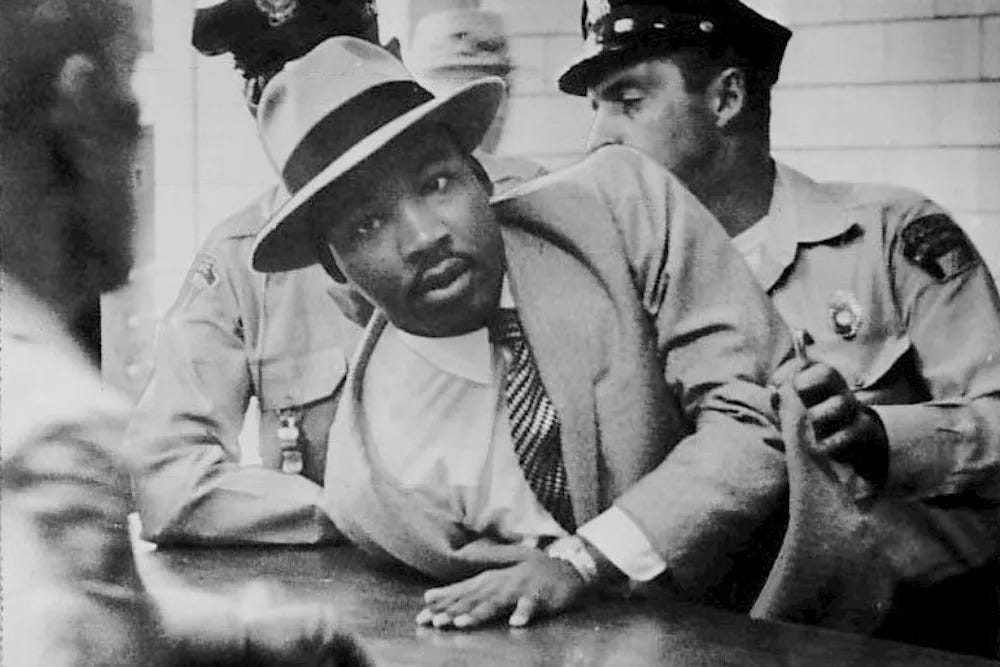
I am completing this Letter on January 19, Martin Luther King Day. Dr. King (1929-1968), an American Christian martyr, bravely endured the pain and terror of Jim Crow and white supremacy. Nevertheless, like Campbell, he viewed America as a whole, made up of black and white citizens alike, who must learn to live together and care for one another. Speaking on the National Mall on August 28, 1963, he said, “I have a dream that one day little black boys and girls will be holding hands with little white boys and girls.” It is not surprising that President Trump argues that his January 6, 2021 crowd rivaled that of Dr. King’s in 1963. Sadly, the president is 200,000 people short. Considered in that light, it is also unsurprising that the president has sought to diminish Dr. King’s reputation in recent days. Truly courageous individuals are not threatened by the witness and accomplishments of others. (Qui, NY Times & Mills, Outside)
SOURCES
Cobert, Jessica, “Majority of Americans Agree Trump Is Weaponizing DOJ to Target Political Enemies,” Constitutional Accountability Center, October 24, 2025. https://www.theusconstitution.org/news/majority-of-americans-agree-trump-is-weaponizing-doj-to-target-political-enemies/
Collins, Jon, “Fear factor: Intimidation becomes a calling card as Twin Cities ICE surge widens,” Minnesota Public Radio, July 16, 2026. https://www.mprnews.org/story/2026/01/16/ice-tactics-in-twin-cities-turn-toward-intimidation
Durante, Alex, “Trump Tariffs Are Raising Prices for Consumers, Latest Evidence Shows,” The Tax Foundation, Oct. 21, 2025. https://taxfoundation.org/blog/trump-tariffs-raise-prices-consumers/#:~:text=
Fischer, Amy, “Third-Country Deportations: Another Cruel Piece of President Trump’s Anti-Immigrant Agenda,” Amnesty International, Sept. 18, 2025. https://www.amnestyusa.org/blog/third-country-deportations-another-cruel-piece-of-president-trumps-anti-immigrant-agenda/
Herschel, Abraham, J., The Prophets, New York: Harper, 1962.
Joselow, Maxine, Friedman, Lisa, “Trump Halts 5 Wind Farms Off the East Coast,” New York Times, Dec. 22, 2025. https://www.nytimes.com/2025/12/22/climate/trump-offshore-wind-farms.html
Margolius, Marc, “Cultivating Jewish Courage (Ometz Lev),” My Jewish Learning. https://www.myjewishlearning.com/article/cultivating-jewish-courage-ometz-lev/#:~:text=
Metzger, Bruce M., “Introduction to Amos,” The New Oxford Annotated Bible: Revised Standard Version, Oxford University Press: New York, 1962.
Mills, James Edward, “National Parks Are No Longer Free on MLK Day. Here’s Why That Hurts,” Outside Magazine, January 18, 2026. https://www.outsideonline.com/culture/opinion/national-parks-mlk-day/
“Prophecy in the Old Testament,” Society for Study of the Old Testament. https://www.sots.ac.uk/wiki/prophecy-in-the-old-testament/#:~:text=
Qiu, Linda, “Trump Claims Jan. 6 Crowd Rivaled the 1963 March on Washington. Estimates Say Otherwise,” New York Times, Aug. 8, 2024. https://www.nytimes.com/2024/08/08/us/politics/trump-jan-6-mlk-crowds.html?
Stover, Lina, “Immigration uncertainty is weakening Nebraska’s families and economy,” Nebraska Examiner, July 24, 2025. https://nebraskaexaminer.com/2025/07/24/immigration-uncertainty-is-weakening-nebraskas-families-and-economy/
“Trump’s Protectionist Trade Policies Allow China to Swoop In,” U.S. News & World Report, Jan. 16, 2026. https://www.usnews.com/news/business/articles/2026-01-17/trumps-protectionist-trade-policies-allow-china-to-swoop-in
PHOTO CREDITS
A Leap of Faith, Micah and Sammie Chaffin, Big Sur, CA
The Prophet Amos, Gustave Dore (1832-1883)
Writing the Declaration of Independence, Virginia Museum of Culture and History
Martin Luther Kings Arrested for ‘Loitering’ in Montgomery, 1958, Wikipedia
Will you be preaching at St. Boniface on March 8? Carol and I are going to the Hill Country for a few days then and we would like to worship with you then.
Thanks Jim Johnson
I’m looking forward to learning more about the prophet Amos.